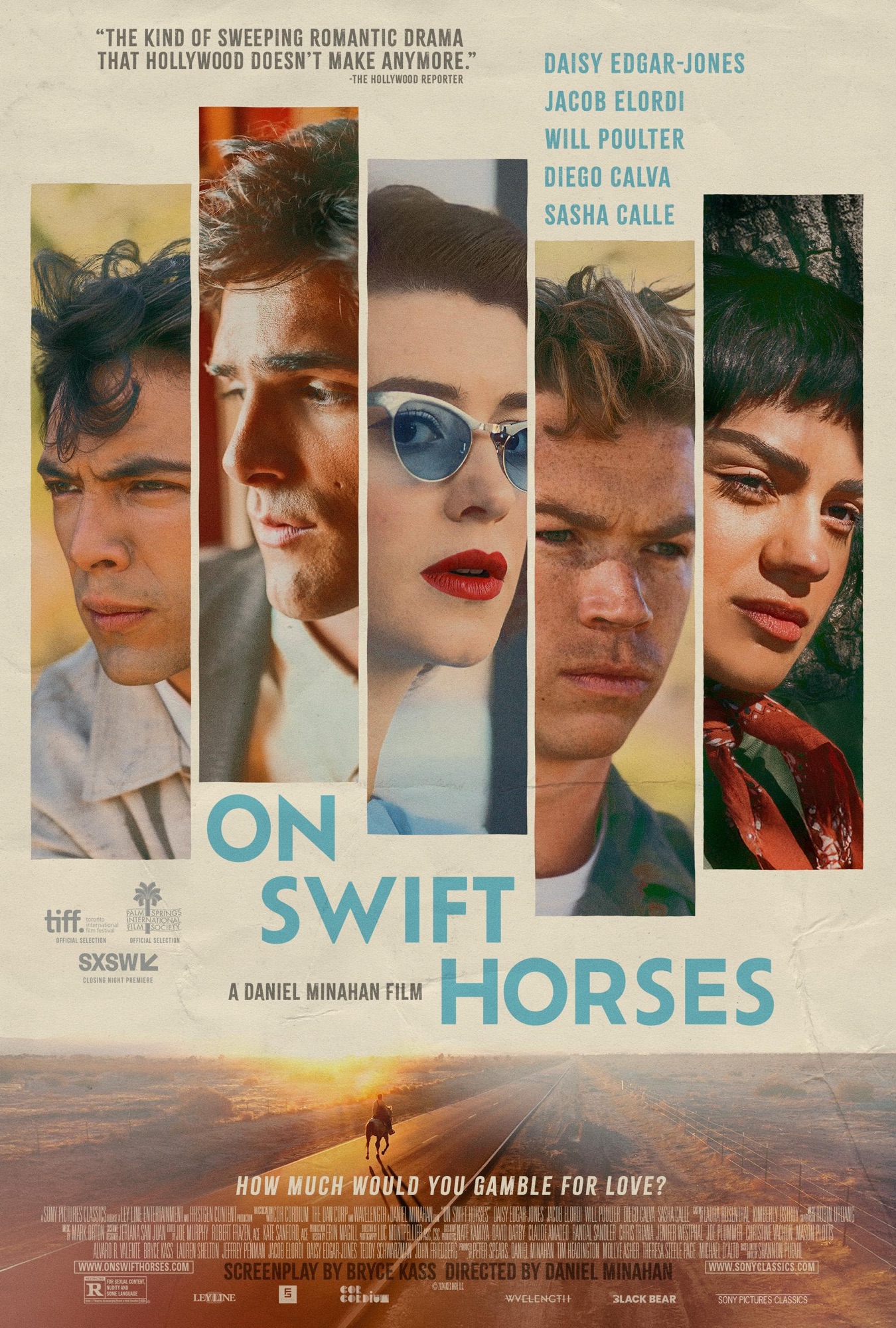


Daniel Minahan’s On Swift Horses unfolds— a memory half-recalled—its edges blurred, its center pulsing with longing. The film is not so much a story but a quiet reckoning, a meditation on our lives in secret and the desires that gallop beneath the surface. Anchored by Daisy Edgar-Jones’ restrained yet emotionally resonant performance as Muriel, the film moves through post-war California and the neon haze of Las Vegas with a kind of haunted grace, tracing two parallel queer love stories that never quite intersect but echo each other in ache and urgency.

Muriel’s journey begins in the sunlit promise of San Diego, where she and her husband Lee (Will Poulter) attempt to build a life after the war. But the arrival of Julius (Jacob Elordi), Lee’s younger brother, cracks the surface. Julius is restless, magnetic, and untethered. His departure for Las Vegas marks the beginning of the film’s dual narrative: one thread follows his secret romance with Henry (Diego Calva), a casino co-worker; the other follows Muriel’s descent into gambling and her unexpected love for Sandra (Sasha Calle), a neighbor whose presence feels like a quiet revolution.

Minahan’s direction is most effective when it leans into silence—when characters linger in doorways, when glances stretch across rooms, and when the sound of hooves on dirt replaces dialogue. The title On Swift Horses is not merely metaphorical; it becomes a motif for escape, for the speed at which desire can upend a life, for the way love—especially forbidden love—demands motion. Muriel’s gambling addiction is not treated as a spectacle but as a ritual, a way of reaching for control in a world that keeps slipping from her grasp. Julius, too, gambles—on love, secrecy, and the fragile hope that he and Henry might carve out a life together in a motel room lit by flickering lamps.

The film’s strength lies in its refusal to resolve discomfort. Muriel and Julius are not healed by love; they are complicated by it. Their stories do not culminate in triumph but in quiet recognition. The interconnectedness of their journeys—both queer, both shaped by addiction, both marked by longing—suggests that survival is not linear. Minahan seems to argue that the rituals of risk, whether at the racetrack or in romance, are bound by the same hunger: to be seen, chosen, and free.

There are moments when the film falters. The pacing, particularly in the second act, drifts. Scenes in Las Vegas sometimes feel over-stylized, and the motel sequences between Julius and Henry, while tender, occasionally veer into abstraction. The dialogue, too, can be uneven—some exchanges feel overly scripted, others too sparse. Yet these missteps never entirely derail the film’s emotional core. Edgar-Jones and Elordi carry the weight of their characters’ contradictions with quiet conviction, and Calva and Calle bring warmth and depth to roles that could have easily been reduced to narrative devices.

The plot succeeds in its ambition but not always in its execution. It wants to be a tapestry of longing, and while some threads fray, the overall weave holds. The dual love stories do not mirror each other so much as they hum in parallel, each revealing the cost of secrecy and the grace of small rebellions. Muriel’s final scenes—her gaze fixed on the racetrack, her hand brushing Sandra’s—are among the film’s most affecting. They do not offer resolution, but they do offer truth.

Thematically, On Swift Horses is rich. It explores LGBTQ awareness not through declaration but through gesture. It does not preach; it listens. Addiction is not dramatized but dignified, shown as a symptom of deeper unrest. The film’s refusal to separate these themes—to treat love and risk as intertwined—is its most compelling choice. Minahan’s vision is clear, even when the narrative wavers.

As a whole, the film works. It is not flawless, but it is sincere. It honors the dignity of ordinary survival, the hush of memory, and the ache of what might have been. Its imperfections feel earned, and its beauty is quiet but persistent. The direction is thoughtful, if occasionally indulgent, and the performances are in tune with the film’s emotional landscape.

On Swift Horses is a film that remembers more than it tells. It leaves behind not answers but echoes. And sometimes, that is enough.

Grade: B+. Streaming on Netflix.


Leave a Reply