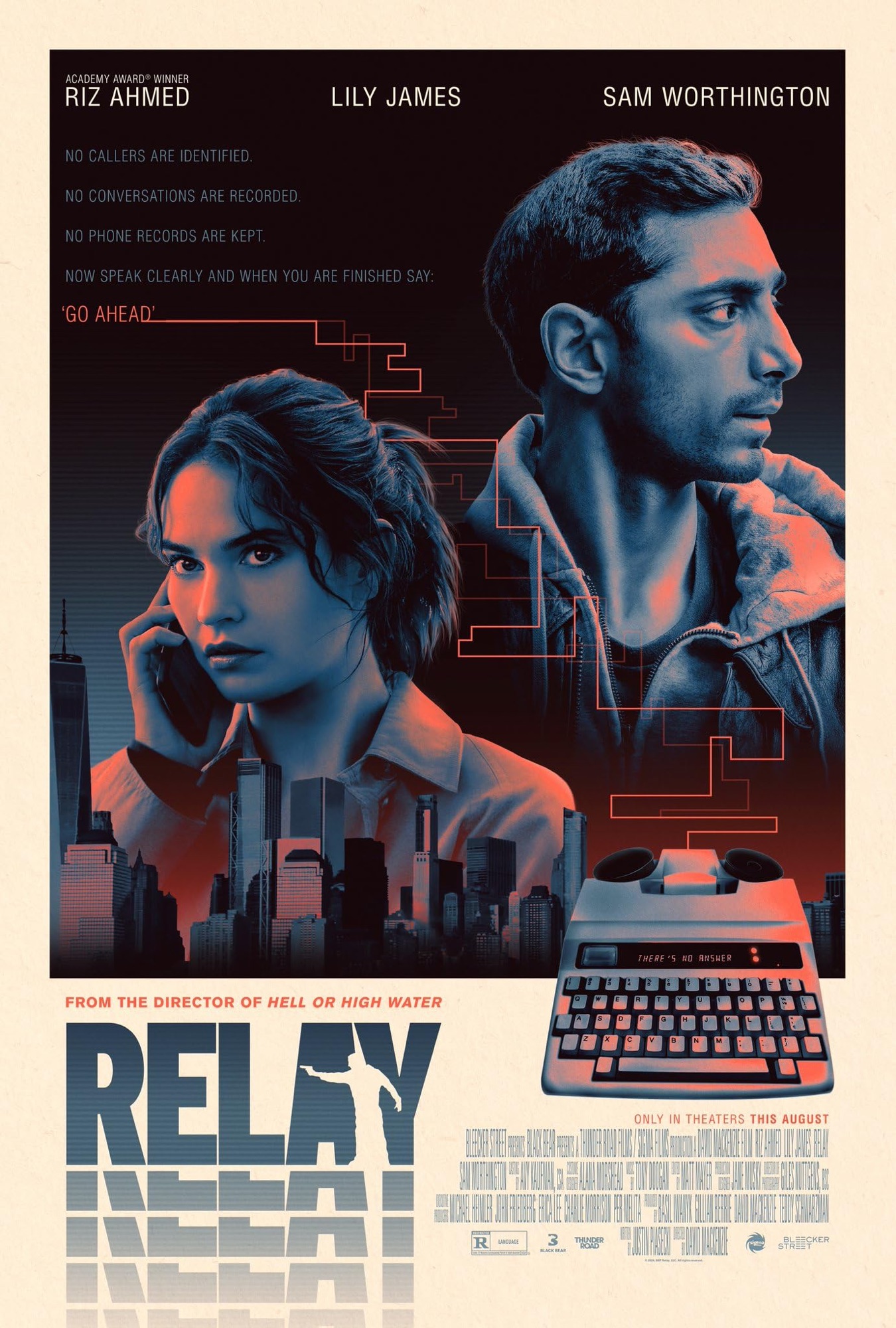


David Mackenzie’s Relay is a film of quiet urgency, a thriller that trades spectacle for surveillance and gunfire for guilt. Riz Ahmed plays Ash, a fixer whose anonymity is his currency, and whose voice is never heard directly. He speaks through relay services, burner phones, and the silence of a man who has seen too much and trusts too little. The film opens in New York, but its emotional terrain is far more desolate. Ash is a man who brokers truth for money, and the cost of that transaction is written across every frame.

The title Relay is not just a nod to the telecommunications device Ash uses to shield his identity. It’s a metaphor for how information, trust, and betrayal are passed from hand to hand, voice to voice, without ever touching the soul. Ash relays messages, threats, instructions—but never intimacy. The film’s structure mirrors this: a series of exchanges, dead drops, and misdirections, each pushing the characters further from connection and closer to collapse. The relay becomes a system of survival and a barrier to truth.

As a thriller, Relay is taut and deliberate. Mackenzie directs with restraint, allowing tension to build through silence and stillness. The surveillance scenes are precise, the counterintelligence maneuvers intricate, and the pacing never rushes. There are no explosions, no car chases, but the stakes feel real. The film understands that espionage is often about waiting, watching, and knowing when not to act. It’s a slow burn, but the embers glow with menace.

The romance, if it can be called that, is a deception built on necessity. Lily James plays Sarah Grant with a brittle vulnerability that masks her true allegiance. Her scenes with Ahmed are charged with ambiguity—are they allies, lovers, or adversaries? The answer shifts with each act, and the final reveal reframes every glance and gesture. Their connection is born of loneliness, not love, and the betrayal cuts deeper because of it. The film doesn’t romanticize their bond; it mourns it.

Ahmed’s performance is the film’s anchor. He plays Ash as a man hollowed out by compromise, yet still clinging to a sliver of integrity. His eyes carry the weight of decisions made in silence, and his body language speaks volumes. He is in tune with the film’s themes: the erosion of truth, the isolation of those who seek it, and the cost of staying clean in a world that rewards filth. His scenes in AA meetings, especially with Eisa Davis’s Wash, are among the film’s most affecting. They offer glimpses of a man who wants to be whole, but no longer knows how.

The plot succeeds in its complexity, though it occasionally strains under its architecture. The twists are earned, but the final act feels rushed. The revelation of Sarah’s proper role is powerful, yet her motivations remain underexplored. The warehouse showdown is gripping, but the emotional fallout is brief. The film could have lingered longer in its aftermath, allowing the characters to reckon with what they’ve done and lost. Still, the narrative holds together, and its moral ambiguity is compelling.

The theme of personal integrity in a compromised world is well presented. Relay doesn’t preach, but it does probe. It asks what it means to do the right thing when the right thing is punished. It explores the loneliness of truth-seekers, the seduction of silence, and the fragility of trust. The relay service becomes a symbol of communication without connection, truth without intimacy. The film’s final gesture, Ash mailing the payoff to the relay center, is poetic and pointed. It’s a tribute to the system that protected him, and a quiet act of restitution.

Mackenzie’s direction is confident and restrained. He avoids melodrama, favoring mood and texture. The cinematography captures the cold geometry of cities, the anonymity of public spaces, and the claustrophobia of surveillance. The score is minimal, allowing ambient sounds to dominate. The film feels lived-in, not staged, and its realism enhances its emotional impact. Mackenzie trusts his audience to follow the threads, and that trust pays off.

Where the film falters is in its emotional depth. The characters are compelling, but their inner lives remain partially obscured. Sarah’s arc, in particular, could have benefited from more clarity. Her deception is effective, but her humanity is underdeveloped. The supporting cast—Sam Worthington, Willa Fitzgerald, Matthew Maher—deliver solid performances, but their roles are functional rather than transformative. The film is more interested in systems than souls, and that choice, while thematically consistent, limits its resonance.

Relay is a film of quiet power, a thriller that whispers rather than shouts. It successfully explores espionage, deception, and the loneliness of integrity. It’s not flawless, but its flaws are part of its texture. It’s a story about passing things on—information, guilt, hope—and what gets lost in the handoff. In the end, Ash boards a train, alone but not defeated, carrying the weight of truth in a world that prefers silence.

Grade: B+.


Leave a Reply