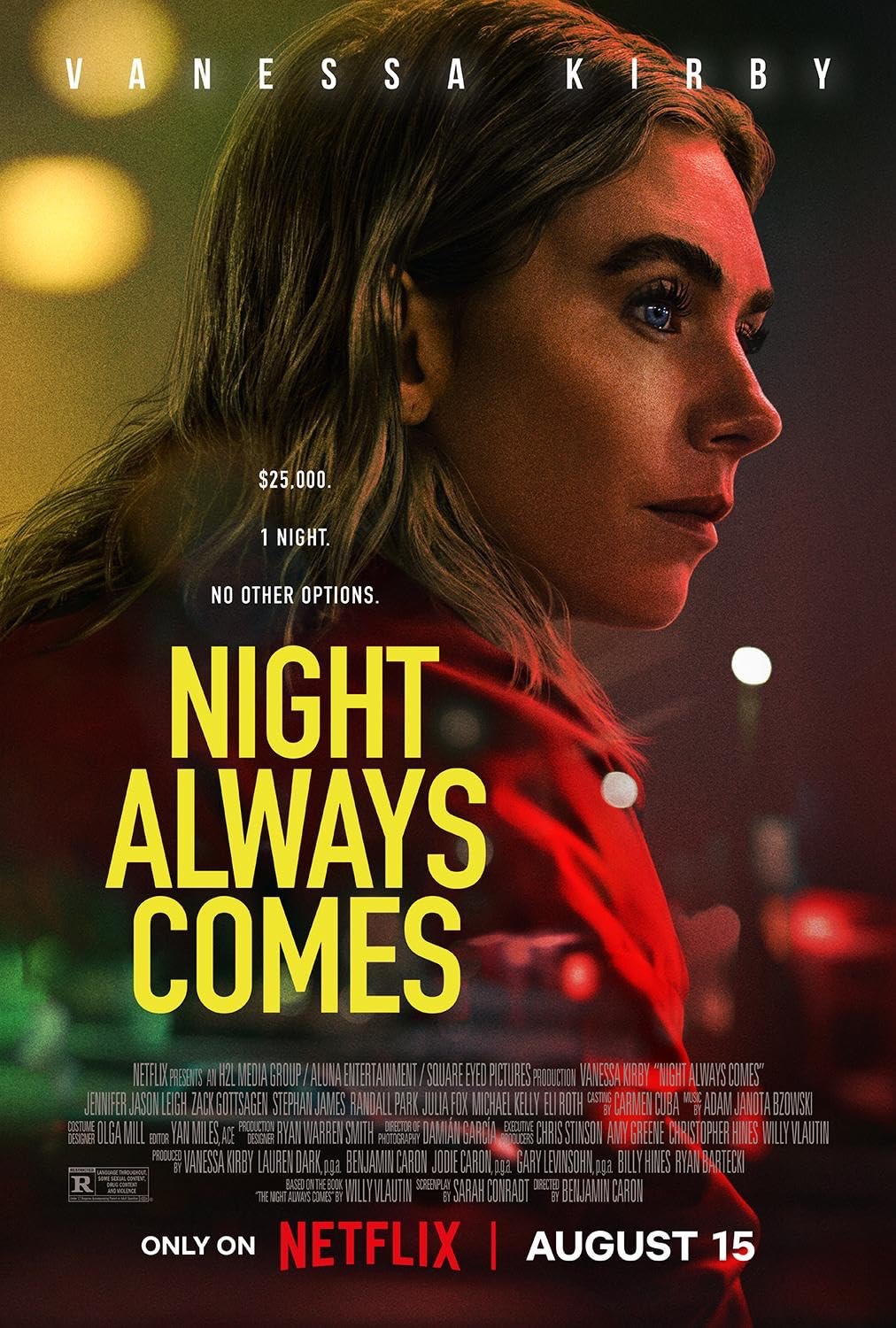


Vanessa Kirby’s Lynette does not walk through Night Always Comes—she scrapes, pleads, and burns through it. Her performance is a tremor held in the jaw, a woman whose body has become a ledger of debts unpaid and promises broken. The film opens with her already exhausted and cornered, and the following night is not a descent but a continuation. Benjamin Caron directs with a steady hand, letting the camera linger on Lynette’s face like a battlefield. The film’s power lies in its refusal to offer reprieve. The night always comes, and for Lynette, it never ends.

The film’s view of family is both tender and cruel. Kenny, played with luminous innocence by Zack Gottsagen, is the film’s heart, and the scenes between him and Lynette are its most honest. Their bond is not sentimental—it is survival. But Doreen, their mother, played with chilling detachment by Jennifer Jason Leigh, is a wound that never closes. Her betrayal is not dramatic but casual, a shrug that undoes years of sacrifice. The film affirms family as a site of devotion and duty, only to undercut it with the reality that blood does not guarantee loyalty.

The title, Night Always Comes, is not a metaphor. It is a sentence. The film is structured around time, each hour a tightening noose. The night is not symbolic—it is literal and long. As Lynette moves through Portland’s underbelly, the darkness becomes a kind of witness. It does not judge her, but it does not help her either. The night is indifferent, and that indifference is the film’s most honest gesture.

The plot, while urgent, sometimes falters under its weight. The shift from character study to crime thriller is abrupt, and though the stakes are clear, the emotional through line occasionally thins. The confrontation with Doreen near the end is meant to be cathartic, but it lands with less force than it should. The script gestures toward reckoning but does not fully arrive. Still, the pacing holds, and the ticking clock keeps the viewer tethered to Lynette’s desperation.

Kirby’s performance is the film’s anchor. She does not play Lynette for sympathy. Her choices are jagged, her silences louder than her pleas. She carries the film’s themes in her posture, her gaze, and her refusal to collapse. The supporting cast, particularly Gottsagen and Stephan James, offer texture and contrast, though some characters—Gloria and Blake—veer toward caricature. Julia Fox’s turn as Gloria is memorable but thin, more spectacle than substance.

Caron’s direction is assured, if occasionally too restrained. The film’s dark, grainy, intimate- matches its emotional tone. Damián García’s cinematography captures Portland as a city of shadows and thresholds, and Adam Janota Bzowski’s score hums with dread. The film’s aesthetic choices are coherent, even when the narrative stumbles. There is clarity in the filmmaking that honors the story’s urgency.

Thematically, the film succeeds in portraying economic precarity as a kind of violence. Lynette’s struggle is not unique, and the film knows this. It gestures toward systemic critique but remains focused on the personal. This choice limits its scope but deepens its intimacy. The film does not offer solutions—it offers witness. It does not preach—it listens. And in that listening, it finds its voice.

Where the film falters is in emotional payoff. The final scenes, though tense, do not fully resolve the ache that has built. There is no redemption, and while that may be the point, the viewer wants a more profound reckoning. The film ends not with closure but with continuation. The morning comes, but the night has not left. This ambiguity is brave, but it risks feeling incomplete.

Still, Night Always Comes is more than a thriller. It is a portrait of a woman who refuses to disappear. It is a study in endurance, the quiet violence of poverty, and the fragile architecture of care. It does not always hit its mark, but it leaves a bruise when it does. Kirby’s Lynette is not a hero, but she is a witness. And in her witnessing, the film finds its truth.

Grade: B+. Streaming on Netflix.


Leave a Reply