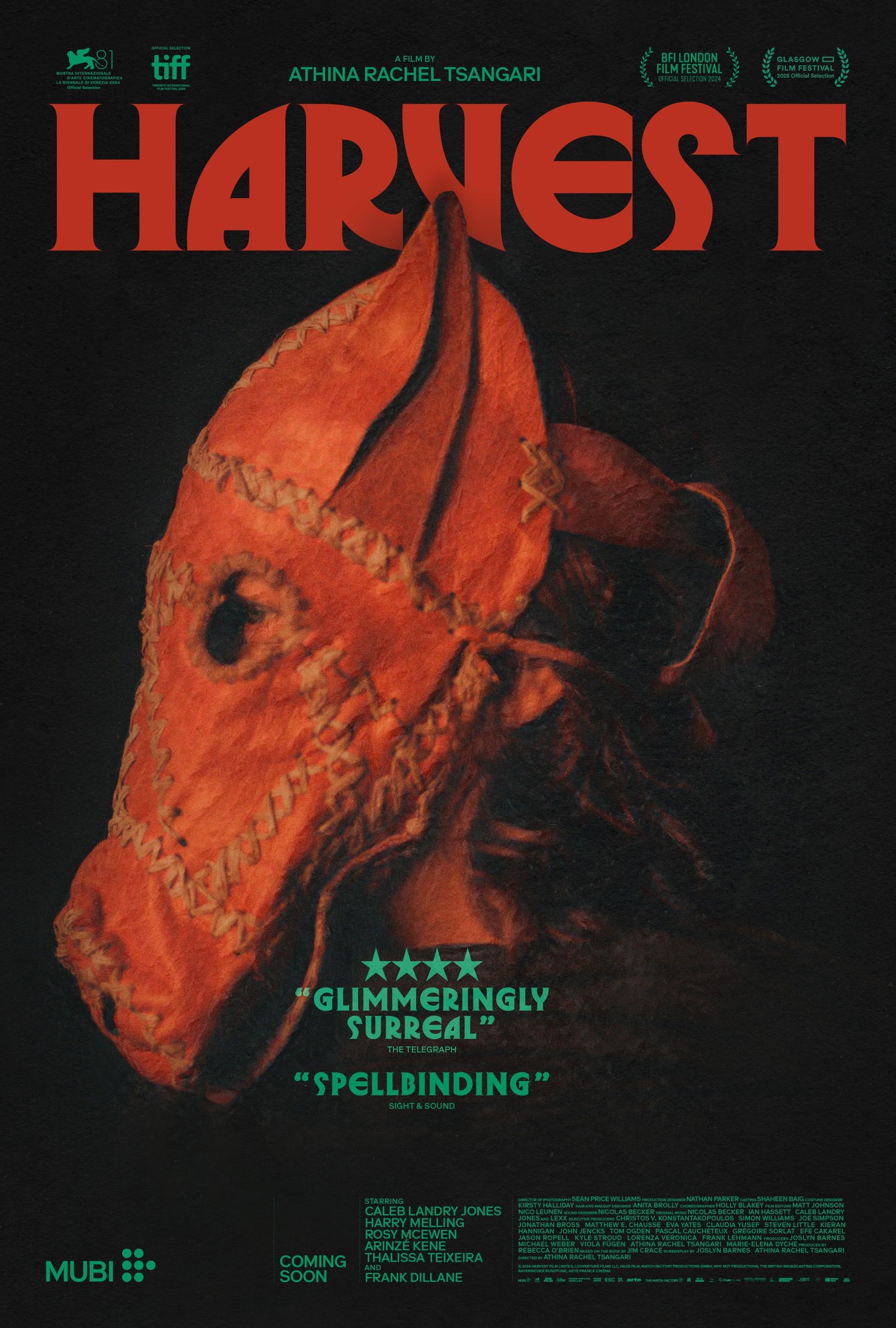


Athina Rachel Tsangari’s Harvest is a film of slow erosion, where the soil of a village is not merely tilled but stripped of its memory. Adapted from Jim Crace’s novel, the story unfolds in a remote Scottish hamlet, its medieval rhythms disrupted not by monsters but by the quiet arrival of enclosure, surveillance, and suspicion. Horror arrives late, but when it does, it is not a scream—it is a verdict. The film’s folk horror is not built on ritual sacrifice or pagan dread, but on the violence of ownership, the severing of communal life, and the ghost of capital.

Caleb Landry Jones plays Walter Thirsk with a kind of internal collapse. His voice-over guides us through the village’s unraveling, not as a prophet but as a witness. He is not heroic, nor is he entirely lucid. His performance is tuned to the film’s moral frequency: half-remembered, half-erased. Jones does not overplay the sickness of memory; he lets it drift. Around him, Harry Melling’s Master Kent offers a portrait of failed benevolence, a man whose kindness cannot withstand the arrival of Edmund Jordan (Frank Dillane), the outsider who brings maps, fences, and the logic of profit.

The plot is deceptively simple. A barn burns. A stranger arrives. A woman is accused. But Tsangari resists the machinery of genre. She lets the village breathe before it suffocates. The horror is not in the fire, but in the decision not to investigate it. The villagers choose unity over truth, and that choice becomes their undoing. The arrival of Mistress Beldam (Thalissa Teixeira) and her brother Quill (Arinzé Kene) introduces ambiguity, not menace. They are not invaders but reminders of what the land once held.

The film’s critique of capitalism is not didactic. It is embedded in gestures: the measurement of fields, the drawing of borders, and the naming of property. The camera lingers on hands, soil, and the slow replacement of communal labor with individual fear. Tsangari does not preach. She mourns. The political dream of the village—shared work, shared harvest—is undone not by violence but by paperwork. The horror is bureaucratic, and that makes it harder to resist.

Where the film falters is in pacing. The first half is so patient and textured that the second half’s descent into accusation and exile feels rushed. The emotional weight of Kitty Gosse’s (Rosy McEwen) betrayal and the villagers’ complicity is undercut by the resolution speed. Some moments beg for silence, for pause, and Tsangari sometimes moves past them too quickly. The dream dissolves, but we are not always given time to grieve it.

Still, the direction is often exquisite. Tsangari frames the village not as a relic but as a living organism. Her use of natural light, attention to the rhythms of labor, and refusal to romanticize the past serve the film’s vision. She does not indulge in spectacle. Even the burning barn is shot with restraint. The horror is not in the flames but in the villagers’ faces, in their decision to look away.

The ensemble cast is uniformly strong. Frank Dillane’s Edmund Jordan is chilling not because he shouts, but because he smiles. Arinzé Kene’s Quill is a quiet force, his presence unsettling not because he is strange, but because he is familiar. Teixeira’s Mistress Beldam carries the film’s moral weight, her dignity unbroken even as she is cast out. These performances are not showy. They are in tune with the film’s refusal to resolve.

The themes are well presented, though not always fully explored. The idea of land as memory, of community as resistance, is powerful. But the film sometimes hesitates to push further. The political dream is glimpsed, then lost. The horror of enclosure is felt, but not consistently named. This restraint is admirable, but it leaves specific questions unanswered. What survives after the harvest? What grows in the soil of betrayal?

Harvest works best as a mood, a lament, a political elegy. It is not a perfect film. It misses beats. It rushes endings. But it holds something rare: a vision of horror that does not rely on blood, but on forgetting. It asks what happens when the land no longer remembers us, and when we no longer remember each other.

Grade: B+. Streaming on Mubi.


Leave a Reply