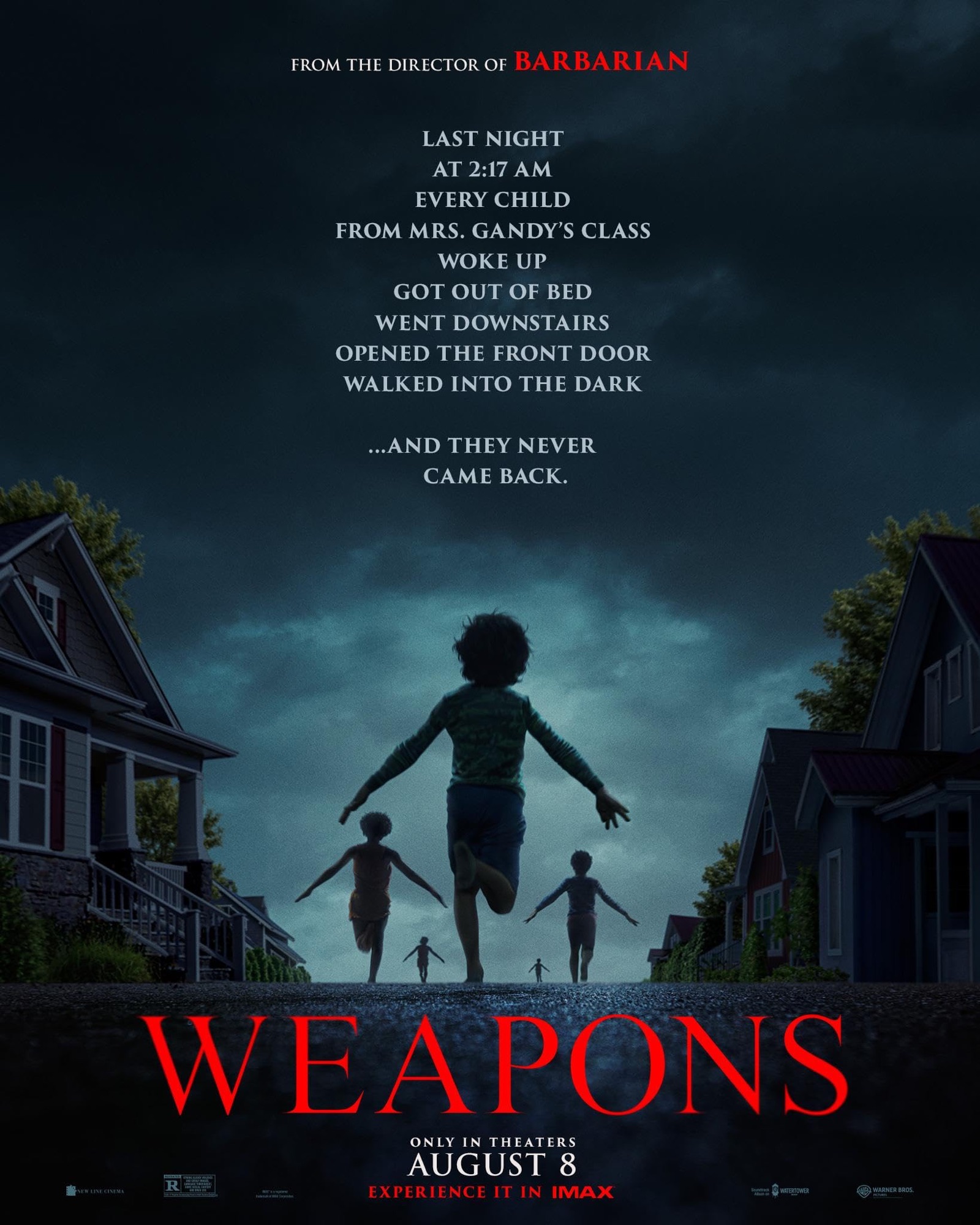


There is a sickness in Maybrook, and it does not arrive with thunder or blood, but with silence. Weapons, directed by Zach Cregger and starring Julia Garner, opens with a quiet horror: seventeen children vanish at 2:17 a.m., leaving behind only one boy and a teacher who will not be believed. What follows is a film of converging griefs, of lives unraveling in parallel, stitched together by a witch who feeds on memory and inheritance. It is a film that dares to be mournful before it is monstrous, and that choice—while not always successful—gives it a haunted dignity.

Garner’s Justine Gandy is the film’s aching center, a woman undone by suspicion and guilt, who drinks and drifts and dreams of the children she lost. Her performance is raw and restrained, never reaching for sympathy, only truth. Josh Brolin’s Archer Graff, the grieving father, mirrors her descent, and their eventual alliance feels earned, not forced. Alden Ehrenreich’s Paul Morgan, the compromised cop, is less compelling—his arc feels more like a plot device than a character study. Still, the cast is well-used mainly, especially Amy Madigan as Gladys, whose quiet menace gives the film its most chilling moments.

Cregger’s direction is confident but uneven. He excels in atmosphere: the newspaper-covered windows, the trance-like parents, the slow dread of a town unraveling. But the pacing falters in the middle, where the film leans too heavily on exposition and loses the eerie rhythm it builds so well. The multiple-character episodes—Justine, Archer, Paul, James—converge, but not always gracefully. Some threads feel rushed, others linger too long. Yet when the film returns to its central horror, it regains its footing.

The witch metaphor, embodied by Gladys, is both literal and symbolic. She is not just a supernatural predator but a figure of generational rot, feeding on the young to sustain the old. Her rituals, her tree, her threats—they resonate with a kind of folkloric terror. And when the children finally turn on her, it is not cathartic but tragic. The horror is not in her death, but in what she took before it. The metaphor mostly works, though it teeters near camp in the final act. Still, it avoids the cheapness of many modern horror climaxes.

Compared to similar films—Hereditary, The Witch, The Babadook—Weapons is less precise but more emotionally sprawling. It lacks the formal rigor of Eggers or Aster, but it reaches for something more communal: the horror of a town, not just a family. It shares DNA with It and The Ring, but trades spectacle for sorrow. That trade-off won’t satisfy everyone, but it gives the film a distinct voice.

The plot is hit and miss. The initial mystery is gripping, and the slow reveal of Gladys’s power is well-handled. However, the James subplot feels extraneous, and Paul’s descent into possession is abrupt. The final confrontation, while visually arresting, leans too heavily on genre tropes. Still, the emotional throughline—Justine and Archer’s search for meaning in the face of madness—holds firm.

The theme of possession, both literal and emotional, is well-presented. The film is less about demons than what we do when we lose control of our children, partners, and selves. The children’s catatonia, the parents’ trances, Marcus’s hypnotized violence—all speak to a more profound fear: that love can be weaponized, that care can be corrupted. It’s a theme that lingers long after the credits.

Cregger’s direction is strongest when he trusts silence. The nightmares, the rituals, the slow walks through empty homes—these moments sing. When he leans into action, the film stumbles. But his vision is clear, and his commitment to emotional horror is admirable. He does not flinch from grief, making Demons more than just a scare machine.

Weapons uses its title to explore the emotional, social, and literal tools people wield to harm or protect—shame, silence, fists, and fear. Through fragmented character episodes that converge around a brutal death, the film builds tension not through plot twists but through moral unraveling. The witch metaphor, if read symbolically, adds resonance by casting the town as a complicit coven and its characters as hunters, scapegoats, and possessed. While the film resists supernatural horror, its emotional payoff is devastating, revealing how ordinary acts become weapons in the absence of truth.


Grade: B+.


Leave a Reply