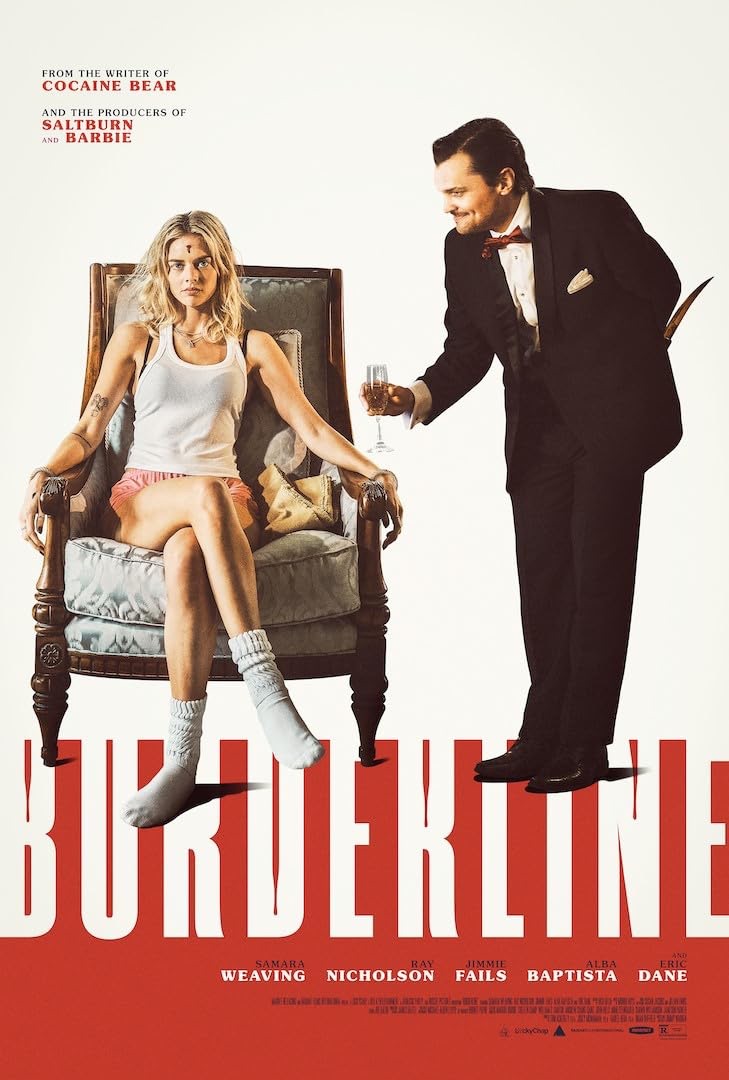


In Borderline Jimmy Warden directs with a taste for the absurd, the unsettling, and the kind of fanfare that thrums behind obsession. Borderline lands somewhere between fever dream and exploitative thrill ride—but it rarely stays in one genre long enough to unpack its luggage. This is a movie that jerks, dazzles, whimpers, and chuckles inappropriately at funerals.

Samara Weaving plays Sofia Minor with brittle charm and pop-star exhaustion. She doesn’t carry the film so much as let it rattle around her. Her character is less built than unwrapped—a woman constantly reinterpreted by others, especially Ray Nicholson’s unsettling Paul Duerson, whose hallucinations often turn the frame into a hostage situation. Nicholson punches through reality with deranged sincerity, giving the film most of its teeth and far too much tongue.

The plot lurches and thrashes- a stalker’s scrapbook. There are abductions, church weddings to people you’ve mistaken for someone else, and a beard that casts a metaphysical shadow. It unfolds in blood and confusion, splicing comedy into trauma- someone cutting a rom-com trailer over hostage footage. It’s reckless, sometimes compelling, but also often incoherent in pacing—thudding forward when it should breathe, and circling back to old tricks that miss their mark.

Warden’s direction is confident but twitchy. He stages sequences with the brashness of someone allergic to subtlety. When it works, it works beautifully—especially in the final church scenes, which lean fully into surrealism. But other stretches suffer from tonal indigestion—the midpoint sags under forced confrontation and stilted dialogue that wants to mean more than it earns.

Unlike The Fan (1996) or Ingrid Goes West, Borderline plays more like the feral cousin who missed therapy and found a knife. It’s not as tight or grounded, nor does it go for pure satire like Beau Is Afraid. Yet it still flirts with meta-horror and fame psychosis in ways that feel timely, if not fully articulated.

Themes of parasocial delusion and fame-as-myth are present, though not always well structured. The film gestures at inherited trauma through the character of Bell and his daughter Abby, but these threads are undercut by abrupt tonal shifts. Still, Eric Dane brings weathered gravity to Bell, grounding his scenes even when shot in the head mid-rescue.

Alba Baptista and Patrick Cox as Penny and J.H. bring a chaotic energy, but they’re poorly sketched—more accessory than accomplice. Jimmie Fails does sharp work as Rhodes, the reluctant boyfriend swept into madness and stabbings. His late-stage performance—the confused groom in a shotgun wedding to his stalker—offers just the right balance of horror and comedy.

Where the film goes wrong: it trips over its ambition. There’s a better version somewhere in its bloodline, trimmed of excess and pushed closer to psychological thriller. Where it goes right: in performances, especially Weaving’s tightly wound grief and Nicholson’s total collapse. These two carry the fire even when the scene burns too bright.

Ultimately, Borderline is a hit-and-miss spectacle—a brutal, comic, half-effective descent into obsessed minds and ruined fame. It’s not quite polished or precise, but weirdly memorable in all the wrong and right ways.

Grade: B. Streaming on Peacock.


Leave a Reply