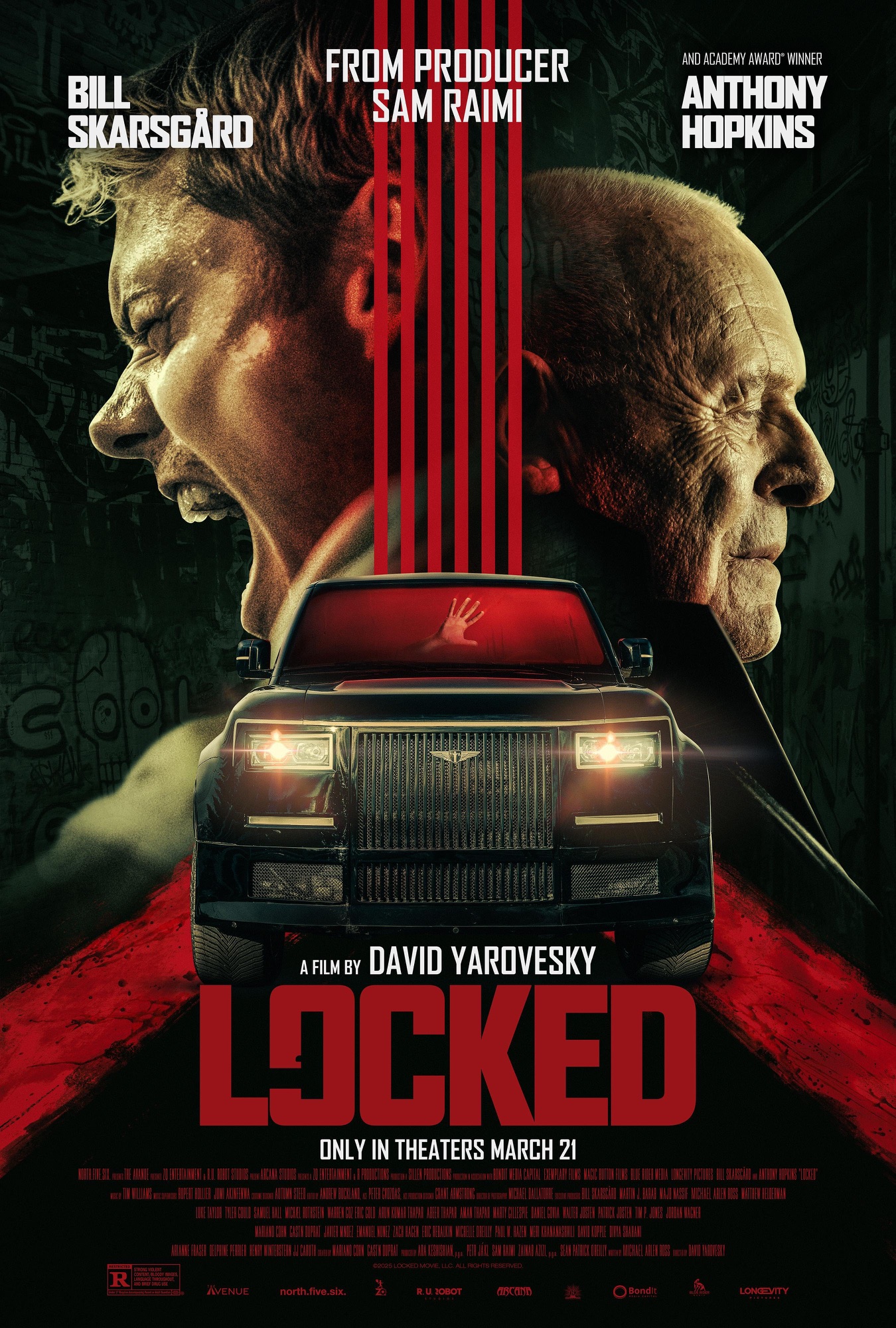


David Yarovesky’s Locked unfolds like a haunted hymn, a tale of punishment and penance sung from the belly of a machine. The Dolus SUV is no mere vehicle—it is a confessional booth, a tomb, a pulpit. Inside it, Eddie Barrish, played with blistered conviction by Bill Skarsgård, is both sinner and sacrament. He is Scrooge in a hoodie, not visited by ghosts but imprisoned by them, each torment a sermon from a dying man who has mistaken vengeance for virtue.

Anthony Hopkins, as William, is the architect of this mobile purgatory. He speaks like a ghost of Christmases gone wrong, his voice a scalpel carving through Eddie’s bravado. Hopkins doesn’t play William—he inhabits him, a man hollowed by grief and swollen with judgment. He is past, present, and future, all at once: the father who lost a daughter, the vigilante who plays God, the dying man who wants to rewrite the ledger before the final breath.

The film’s premise is simple, but its execution is layered. Eddie, desperate and broke, breaks into the wrong car and becomes the latest subject of William’s twisted morality play. The SUV locks him in, shocks him, starves him, and drives him through a gauntlet of humiliation and revelation. The plot succeeds not because it surprises, but because it commits. Each beat is earned, each escalation justified by the slow unraveling of Eddie’s defenses.

Skarsgård is magnetic. He sheds his monstrous past and delivers a performance rooted in grime and regret. His Eddie is not noble, but he is real. He curses, he bleeds, he drinks his own urine. And yet, he grows. The transformation is not grand—it is granular. A man who once stole wallets ends the film pedaling a bike to his daughter, not as a hero, but as a father who finally showed up.

Hopkins is used sparingly, but effectively. His voice is the film’s spine, and when he finally appears in the flesh, it is not a climax—it is a reckoning. He is less Hannibal and more Mephistopheles, offering cookies and cruelty in equal measure. His scenes are theatrical, but never indulgent. He is the ghost who refuses to vanish, the judge who never leaves the bench.

The direction is taut, if occasionally indulgent. Yarovesky leans into the claustrophobia, but sometimes lingers too long on Eddie’s suffering. The pacing stumbles in the middle, especially during the prolonged torture sequences. Still, the film never loses its grip. The final act, with Eddie’s daughter nearly run down and the SUV crashing into flame, is a crescendo of dread and release.

The theme—justice twisted by grief, redemption earned through pain—is well told. The film doesn’t preach, but it does provoke. It asks whether punishment can purify, whether survival is enough, whether love can bloom in a locked box. It doesn’t answer these questions, but it dares to ask them.

Compared to other claustrophobic thrillers, Locked stands apart. It is Christine possessed by moral fury, A Christmas Carol rewritten in blood and gasoline. It is not as sleek as Buried, nor as sharp as Phone Booth, but it is more soulful. It trades polish for presence, spectacle for sincerity.

There are misses—some dialogue strains, some logic bends—but the hits land hard. The film is mostly a success, a chamber piece that sings in minor keys. It is a story of a man trapped by his own choices, and another man trapped by his grief. And in the end, it is the daughter—Sarsh—, untouched by sin—who becomes the reason to break the glass.

Grade: B+. Streaming on Hulu.


Leave a Reply