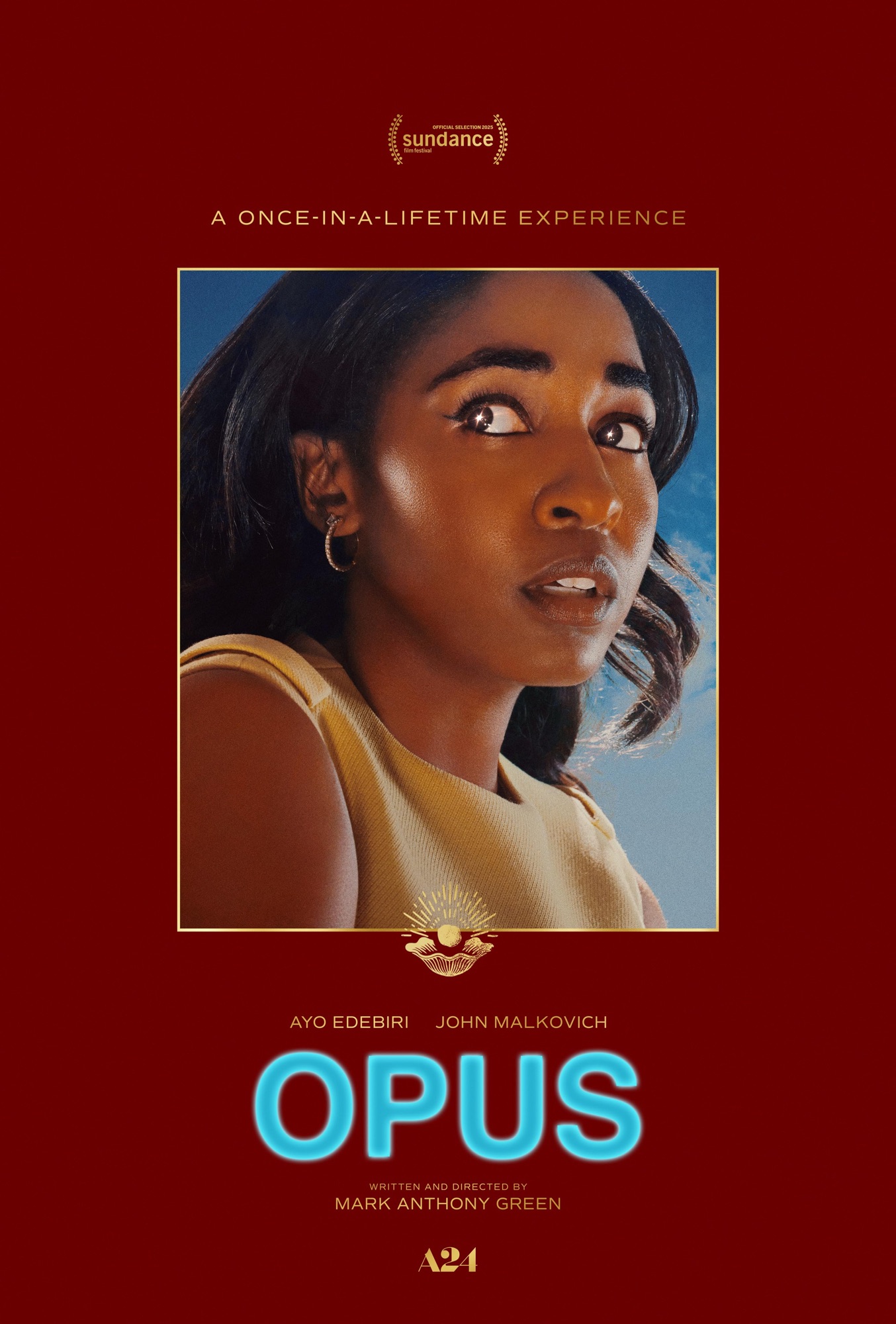


In Opus, director Mark Anthony Green orchestrates a nightmarish requiem for celebrity culture, burning through the lacquered illusions of fame like candlelight against velvet. Anchored by Ayo Edebiri’s poised and perceptive turn as journalist Ariel Ecton, the film juggles psychological horror, dark satire, and cult paranoia—sometimes deftly, sometimes erratically. It’s a fever dream that dares its audience to squint at the spectacle of fading stardom and the predators lingering at its edges.

Set at the eerie Utah compound of Alfred Moretti (John Malkovich), a washed-up 1990s pop star seeking artistic resurrection, the plot places six guests inside a tightly wound social experiment wrapped in ceremonial dread. Malkovich is magnetic, peeling back Moretti’s charm to reveal something unhinged beneath the surface—an aging performer desperate to claw his way back into cultural relevance via a violent cult called the Levelists. His performance is a highlight, both chilling and charismatic.

Where the film succeeds most clearly is in its aesthetic commitment. The compound exudes ritualistic strangeness, and Green’s direction captures the intoxicating draw of spectacle with surreal pageantry—be it the grotesque puppet show or the oyster-shucking symbolism. The recurring visual motifs of pearls, shaving rituals, and identical uniforms suggest a meditation on purification and erasure, though the metaphor occasionally trips over its own feet.

The ensemble cast is well-assembled but unevenly used. Juliette Lewis and Murray Bartlett offer compelling moments as Clara and Stan, but their arcs feel truncated, as if they were swallowed too quickly by the narrative’s descent into madness. Melissa Chambers as paparazzi Bianca and Stephanie Suganami’s Emily contribute haunting images, particularly in Emily’s beanbag suffocation scene. Yet, both characters feel more like symbolic road signs than fleshed-out travelers. Amber Midthunder as Belle is unnervingly serene, adding texture to the cult’s ideology.

Plot-wise, Opus thrives on its unpredictable structure, but suffers from thematic overload. The setup is gripping, and Ariel’s journey from skepticism to survivor is compelling. However, moments that should feel profound—like the puppet show or Moretti’s final monologue—often feel over-scripted or undercut by tonal shifts. The final twist, involving the Levelists’ infiltration into society through Ariel’s book, is haunting but rushed, leaving more questions than resonance.

The film gestures firmly toward a critique of cultural gatekeeping: journalists, influencers, and critics are portrayed as pests, feeding off the corpses of artists. Yet this critique is muddled—what begins as a cautionary tale about fame’s dark underbelly turns into a somewhat scattered take on ideological contagion. The tension between artistic revenge and moral reckoning is intriguing but never fully resolved.

Green’s direction is bold, often too bold. He seems committed to constructing a slow burn, but the pace occasionally stalls, particularly in the middle sections. There’s tonal whiplash between horror, satire, and elegy. Nevertheless, his visual storytelling remains potent, especially in sequences like the barn discovery or the climactic house-museum confrontation. These moments elevate Opus from a cult thriller into something more poetic and unsettling.

The writing walks a delicate line between sincerity and absurdity. Some dialogue—especially between Ariel and Moretti—feels lyrical in intent but doesn’t quite land emotionally. Still, the screenplay deserves credit for its ambition. Its final shot, with Ariel caught in a media haze surrounded by pearl-wearing figures, lingers—a chilling nod to complicity and the unintended consequences of storytelling.

Ultimately, Opus is not a flawless composition. Its instruments clash and chords slip off key, but there’s something undeniably captivating in its attempt to harmonize horror and lament. It may not entirely succeed as a study of fading fame or cult psychology, but it sings a strange, sad tune that refuses to be ignored.

Grade: B+. Streaming on Max.


Leave a Reply