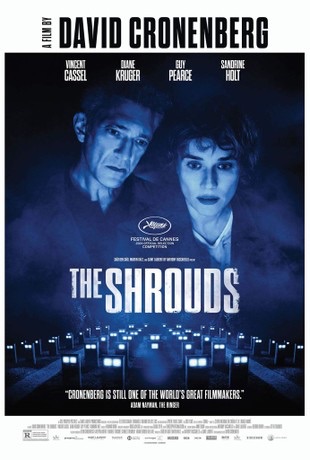


The dead are restless, but not in the way you’d expect. They don’t scream. They shimmer. They peel away in layers of corrupted light. David Cronenberg’s The Shrouds, now streaming on the Criterion Channel, isn’t a ghost story—it’s a fugue composed in grief’s decaying architecture. It moves like a procession through data-sickened catacombs, its horror crumbling quietly beneath polished glass.

Vincent Cassel drapes mourning across his shoulders like a mantle fashioned from unfinished farewells. As Karsh, the grieving architect of GraveTech, he pours his sorrow into machinery that translates death into flickering presence. This invention is no tombstone—it’s a liturgy of desperation, transmitting absence as spectacle. What rises isn’t revulsion—it’s grief that thickens the air around it, expanding until even memory feels suffocated. His performance doesn’t just speak of loss—it breathes through it, carving silence into every line of his face.

Cassel circles three incarnations of Diane Kruger: Becca, the vanished muse; Terry, the sister who carries Becca’s echo in her marrow; and Hunny, the AI mirage that grinds intimacy into bitter code. Kruger moves through the film as a whisper folded into flesh, each incarnation bearing its own decay and allure. Guy Pearce, twitching through Maury’s mania, is grief’s virus—infectious, unpredictable, mutating with each jealous breath.

Cronenberg’s direction is austere, but dread seeps from the film’s bones. Instead of spectacle, he yields to an atmosphere dense with psychic sediment, where each frame reverberates like a pulse trapped beneath glass. Rooms don’t simply exist—they watch. The stillness accumulates, charged with the residue of buried unrest. Yet this precision can also harden the film’s arteries, as philosophical weight settles over the narrative, slowing its heartbeat, making it feel less like movement and more like a quiet sinking.

The story curls inward, swallowing its elegy. Karsh’s entanglements with Terry and Soo-Min bleed with erotic ambiguity, blurring the sacred with the profane. They don’t offer romance—they offer gravity wells. Their intimacy is ritual, laced with thirst and rot. The fragments seduce, but their cohesion dissolves under scrutiny, like fingerprints smeared across wet granite.

And still, the film’s question—can we commune with the dead, or only with the reflections they leave behind?—echoes with staggering resonance. The Shrouds walks alongside its genre ancestors: the spectral melancholy of Her, the technological exorcism of Pulse, the sacrificial horror of Pet Sematary. These aren’t comparisons—they’re ancestral hauntings, stitched into the film’s DNA.

Where The Shrouds finds its power is in texture. Its atmosphere isn’t crafted—it’s conjured. The soundscape breathes like something half-buried. Dialogue unfurls with the weight of ritual—the screen hums with mourning, layered in static and shame. Cronenberg doesn’t give us horror—he offers grief as a cathedral.

This is not storytelling for comfort. It offers no compass. It opens wounds, then recites over them. The plot may stumble, but the spell holds. The Shrouds mourns not just the dead, but the rituals we invent to preserve their echo. It is not a film that ends. It simply fades.

Grade: B+. Streaming now on the Criterion Channel.


Leave a Reply