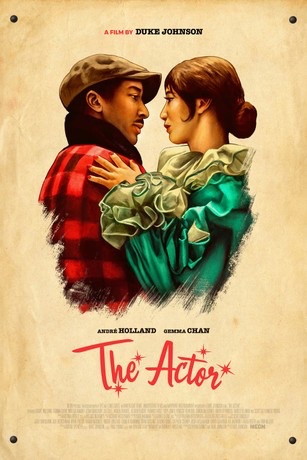


In The Actor, a murky little dream of a film currently playing on Hulu, you’re never quite sure whether you’re watching a noir thriller about memory or a rehearsal for one. The film, directed with an affection for theatrical smudges and slow reveals by Duke Johnson, wears its origins proudly—it’s based on Donald E. Westlake’s novel Memory and dances along like a stage play that got caught in the gears of a fever dream. There are footlights in every glance and cues in every silence. André Holland carries the lead, Paul Cole, as a man with no memory and even less context, who wakes up in a small town that seems built from misremembered postcards and the backlot of a half-forgotten movie. It’s stylish, uncanny, and frustrating, occasionally all at once.
The film begins with Holland’s Paul battered, confused, and blank as a cue card. He doesn’t know his name. Doesn’t know how he landed in a hospital bed. Doesn’t recognize the bruised face in the mirror. You could say The Actor kicks off like an existential detective story, with Holland’s Paul both sleuth and suspect. But he doesn’t have the facts—he has moods, impressions, flickers of anger and longing. Holland, always a soulful actor, plays Paul as a man displaying emotion through muscle memory, his face trying on expressions like secondhand coats.

The town itself is a carefully managed unreality. There are diner booths from the Eisenhower era and wallpaper patterns that might induce mild seizures. A local costume designer, Edna (Gemma Chan), takes Paul in. She’s warm but guarded, a woman with secrets that only unfold when the light hits them just right. Chan plays her not as a real person but as something archetypal: the caretaker, the confidante, the one who stitches a past for the man with none. Their romance is patient and tentative, like courtship in a play whose second act may never come.
The sepia-toned cinematography works like a magician’s scarf—it’s beautiful, draping every scene in golden fog, but you’re also aware something is being hidden. The warmth dulls the sharpness of both memory and reality. It evokes nostalgia, but also anesthetizes. Sometimes you wish the director had gone with something harsher, colder. Still, in its most effective stretches, the palette makes everything feel out of time, as if the characters are trapped in a scrapbook where someone forgot to write the captions.

The cast is a pageant of oddballs and double-cast doppelgängers, as if the town’s population was dreamed up by a repertory company suffering from insomnia. Youssef Kerkour pulls quadruple duty—Black Jack, Ed, the Defense Attorney, the Busdriver—all while maintaining a calm, vaguely sinister charm, as if he’s the innkeeper of Paul’s mind. Tanya Reynolds and Tracey Ullman likewise swirl through roles like trick mirrors, each reflection implying something different. Are they real people in a small town? Are they fragments of Paul’s fractured psyche? Are they metaphors for the masks we wear? Yes. And no. And probably.

But here’s the trouble with dream logic: eventually, you wake up. The plot unfolds not so much like a narrative as a sequence of gasps and shrugs. You’re not pulled along by suspense so much as meandered forward by eerie grace. When the film leans into its unreality, it’s mesmerizing. When it tries to explain itself—Paul’s career, a hinted romance gone wrong, maybe even a crime—it tightens up and loses some of its mystique. The memory-loss trope becomes both a burden and a blessing: the emptiness allows for metaphor, but also flattens emotional stakes. Without a “before,” it’s hard to mourn what’s been lost.

That said, Holland anchors the film with tremendous presence. He never stops listening even when he’s being talked over, manipulated, or misunderstood. You sense the desperation behind his eyes, the pull of something just out of reach. His scenes with Joe Cole’s aggressive Nick sizzle with tension and vague familiarity—friend? Foe? Brother? Rival? It’s never clear, and that’s part of the ache. The whole film aches in a way that feels oddly tender.

There’s pathos, certainly. But the joy, too, is there in how the film doubles back on itself with sly little winks. Asim Chaudhry provides unexpected levity, May Calamawy shows up like a memory you forgot you missed, and Olwen Fouéré practically haunts the screen as Old Lady Track, offering one of those unplaceable performances where every word could be a poem or a curse. It’s a film aware of its artificiality, and sometimes delights in that awareness.
In the end, The Actor is not entirely about memory. It’s about the performance of oneself. It asks how much of who we are depends on what others reflect. The staginess and mannered acting underline that—every conversation sounds slightly rehearsed, every movement just a beat too slow. It can be maddening or beautiful, depending on your mood. Like Westlake’s best work, the film wobbles between noir and farce, sentiment and screwball. You’re never quite sure what kind of movie you’re watching. But maybe that’s the point. Perhaps it’s the kind of movie you remember better a few days later, when the colors fade and the story keeps tapping at the back of your skull like a forgotten cue.

It doesn’t all work, but it doesn’t have to. The Actor slips, but it slips with style.]
Grade: B+, streaming on Hulu.


Leave a Reply