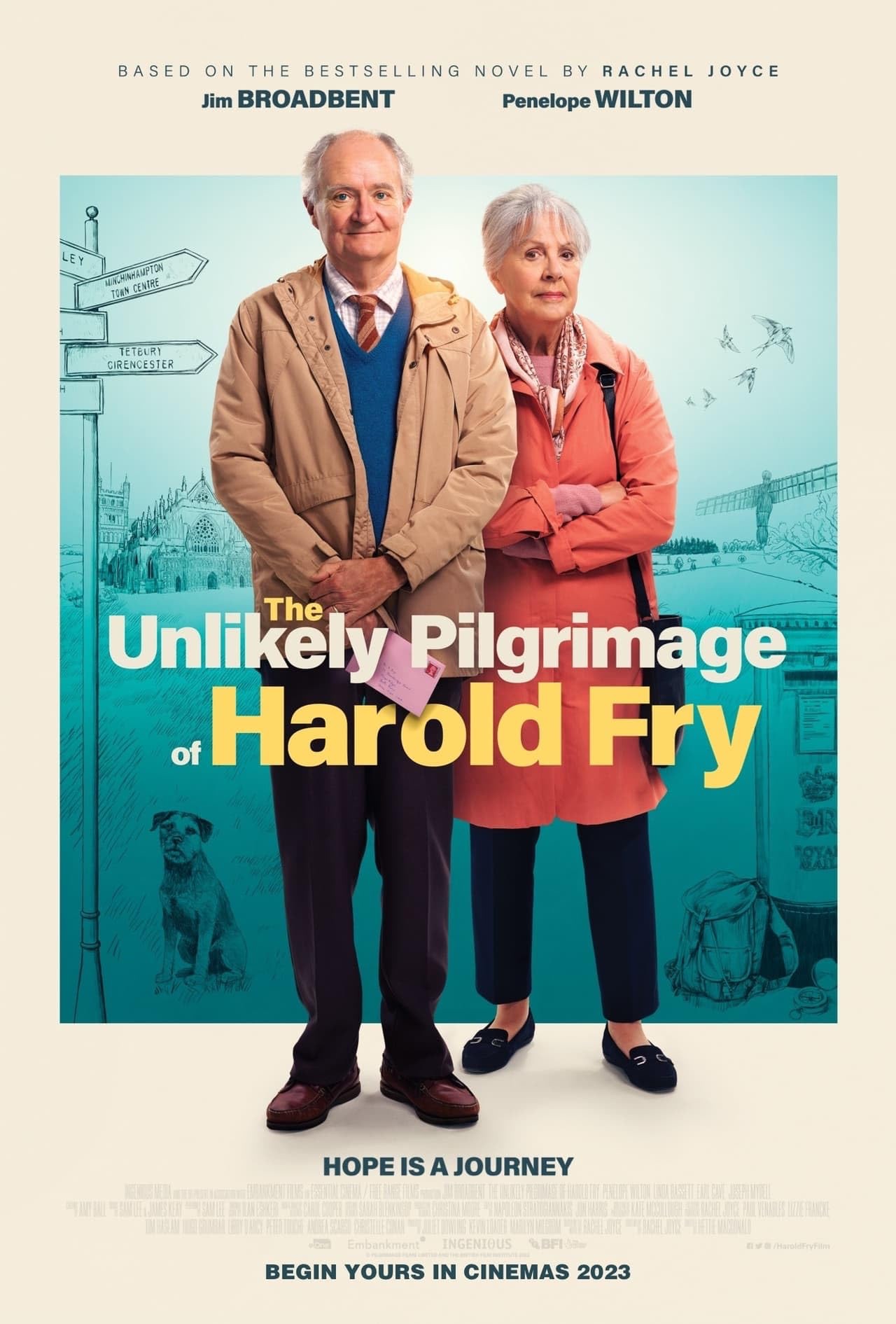


There’s something peculiarly English about a man setting out in boat shoes to redeem his soul by walking across the country without a map, a toothbrush, or a plan. In The Unlikely Pilgrimage of Harold Fry, director Hettie Macdonald crafts a deceptively gentle odyssey, a landscape-wide hush that builds into a roar of grace. Where Americans might roar down Route 66 in search of disillusionment—Kerouac hitchhiking into cigarette-ash epiphany or Thelma and Louise pedal-to-the-metal into oblivion—Harold Fry pads gently toward something far rarer: quiet absolution. The film, headlined by a deeply moving Jim Broadbent, finds its gospel not in spectacle, but in the hush between footfalls.

The film opens in Kingsbridge, where Harold Fry exists more than lives. Broadbent plays him with the sort of inoffensive politeness one might offer a mug of tea left too long on the windowsill: lukewarm and fading. His wife, Maureen (Penelope Wilton, pitch-perfect in her exasperated containment), stands across from him like furniture that’s been rearranged too many times. Their stillness is violently interrupted by a letter from Queenie Hennessy, a woman Harold once knew and perhaps never truly saw, now dying in Berwick-upon-Tweed. And so Harold begins to walk. At first, to the corner. Then, to the postbox. Then, to Queenie. A journey of 500 miles starts with a pair of unfit shoes and a man desperate to matter again.
What follows is not so much a road trip as a soul’s rummage sale. England unspools beneath his soles in sepia tones and sodden fields. Along the way, Harold is met not by eccentricity for its own sake, but by a gentle parade of strangers who stitch together a quilt of modern, immigrant England. Martina (a luminous Monika Gossman) is a Slovakian cleaner with the calm, competent hands of a surgeon and the eyes of someone who’s waited too long for someone to come back. Her home becomes a momentary sanctuary, her kindness a balm without condescension. In the American version of this story, she might be exoticized or diminished. But here she’s part of a larger truth: Harold’s England is changing but hasn’t hardened. His pilgrimage is graced by those who’ve come from elsewhere and decided, improbably, to stay.

The film’s tonal finesse lies in how it treats kindness. There are no grand speeches, no swelling strings to accompany acts of generosity. A garage girl (Nina Singh) shares her story; a young junkie named Wilf (Daniel Frogson) brings both chaos and clarity; a cluster of walking acolytes turns Harold into a reluctant saint. This isn’t Forrest Gump–style mythmaking; it’s something smaller and truer. Harold’s sainthood, if it can be called that, lies in his persistence. Each blister is a benediction: each setback, a psalm.
As Harold trudges forward, Maureen unravels in quiet domestic exile. Wilton, always a master of restraint, lets us see the rot beneath her tidy composure. Her journey is equally spiritual and grueling, but hers takes place among kettle whistles and empty chairs. Where Harold walks toward something, Maureen digs into what remains. Her monologues with Rex (Joseph Mydell) are tinged not just with loneliness but with a private bitterness—at Harold’s retreat, at David’s memory, and at her own silence.

Flashbacks to David (Earl Cave) fracture the narrative like pressure cracks in old glass. He’s the son who slipped away, the wound both Harold and Maureen carry but haven’t quite dared to touch. It is in remembering David—his addiction, his despair, his death—that Harold’s walk becomes less about Queenie and more about exorcising his failure. Broadbent sheds Harold’s politeness like ill-fitting skin as these memories crest, revealing a man wrecked and yearning.
Adapting from Rachel Joyce’s novel, Director Macdonald resists the pull toward sentimentality. Even Queenie (Linda Bassett), when she finally appears, is too far gone to offer catharsis. Instead, what’s provided is presence. A quartz pendant hung in a window. Light caught in the glass. The choice not to flee the room. These are the film’s final sacraments.
Ultimately, Harold’s pilgrimage isn’t about saving Queenie or himself but bringing something intact from the wreckage. In doing so, he saves something: his marriage, or perhaps the memory of what it once was. The final scenes—of strangers touched by him smiling into borrowed sunlight—are achingly earned. It’s not joy, not precisely. But it’s something adjacent—a kind of blessed resignation.
There’s a reason why British road stories so often involve walking. The journey is slower, less dramatic, and more punishing. But in the drag of the foot and the weight of the pack is the space to reckon with. American treks often lead to ruin or absurdity; British ones arrive at fragile hope. The Unlikely Pilgrimage of Harold Fry is soaked in that hope, wrung out and wrinkled, but still clinging to shape. And that is a miracle in an age obsessed with forward motion.

Grade: A. Streaming on Amazon Prime.


Leave a Reply