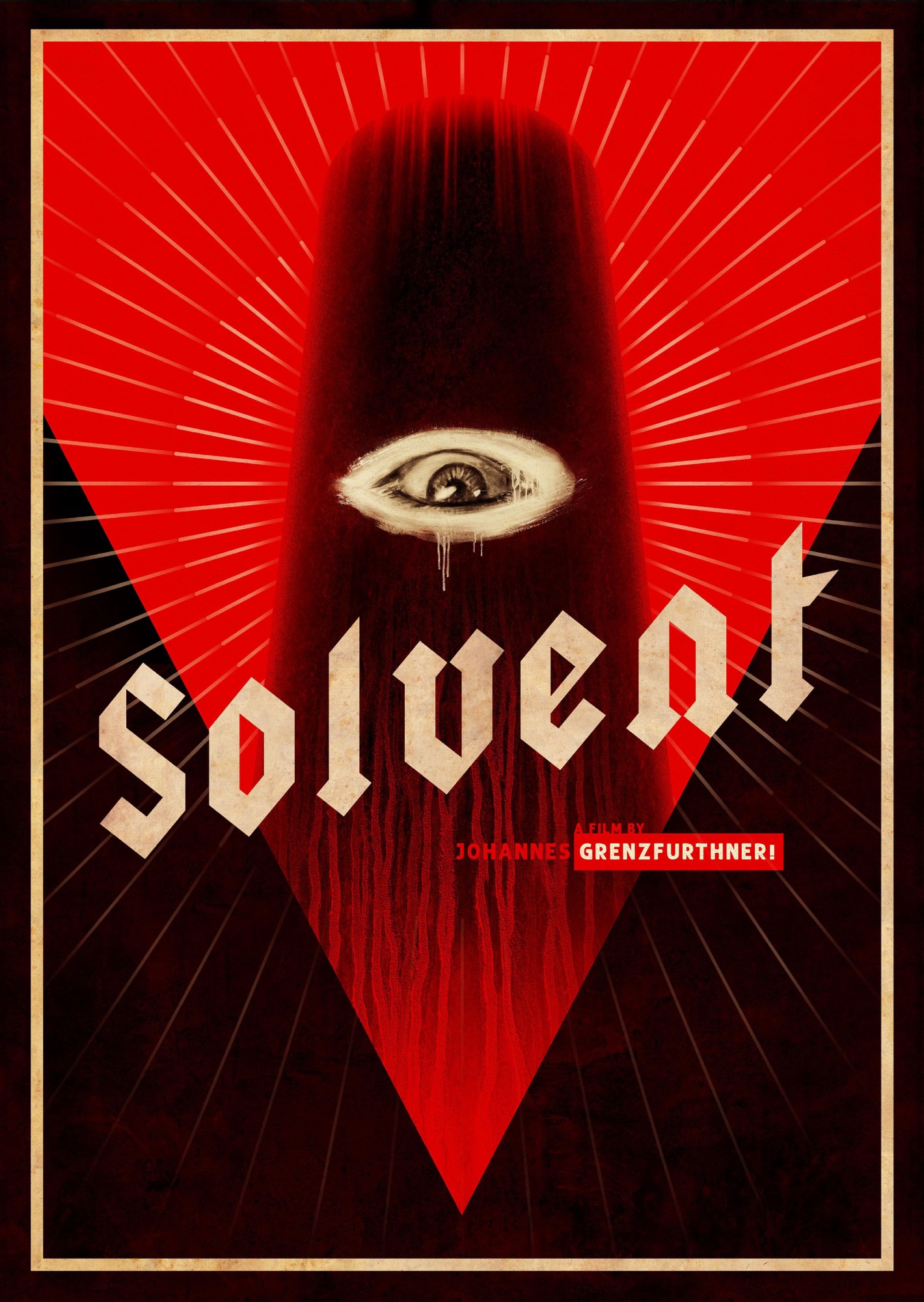


Solvent does not begin. It ruptures. Like a fever breaking under pale light, like memory surfacing in static. From its first frame, the film unspools not in story but in sensation—choppy, quick-cut reveries that lacerate the eye and unsettle the breath. You do not watch Solvent so much as stagger through it, questioning what lingers in your periphery, what your gut insists you’ve just seen. It is horror not as genre but as infection: something that slips under the skin before you can name it.

At its surface, the tale is simple, almost folkloric: a ruined farmstead in the Austrian woods, a vanished patriarch steeped in fascist residue, a team of seekers stumbling into something ancient and vile. But beneath, the narrative buckles and undulates like something alive. Gunner S. Holbrook—an ex-mercenary turned reluctant archivist—guides us through this labyrinth with an unsteady lens. We never see his face, only hear his voice, as though the camera itself has gone sentient, documenting its own descent.

The land remembers. The farm, decayed and crawling with debris, does not merely sit idle—it exhales. It seeps. Bottles of urine line the walls like altars to decay. Hard drives hum like insects with digital hate. History here is not archived—it is pickled, preserved in jars of yellow memory, in algorithms haunted by swastikas. Zinggl the elder, long vanished into the forest, left breadcrumbs of madness—and his grandson Ernst picks them up hungrily, eyes gleaming with inherited delusion.

What were they looking for? A lost relic? Nazi gold? Proof of something that should not be proved? The team doesn’t know. The viewer doesn’t know. And that is Solvent’s genius—it denies clarity, as if truth itself has been corrupted. In the cellar, beneath boards and stone, they find a pipe—a black vein sunk deep into the earth. When the camera is lowered in, what it sees defies logic. It is not horror as spectacle but horror as vertigo. You feel it twist your spine, quietly.

Time fractures. When next we see Gunner, the world has shifted. Months have passed. His partner Krystyna—once sharp, now fractured—rants in ancestral tongues, possessed by something older than language. Her calls become liturgies of liquefaction, destruction, purification. Gunner himself begins to unravel. He stares into the dark pipe, and the dark pipe stares back. Soon he too speaks in German, a language he never knew. The infection is spiritual, existential. It colonizes identity.

He mutters. He twitches. He plays with vermin like a man possessed. Something has taken root in him—in his mind, in his flesh, especially in his most intimate corners. Solvent dares to thread the grotesque through the erotic, the political through the bodily. It touches those places where shame and desire blur. Where transformation is not awakening, but rot. His descent is not cathartic. It is biblical in its dread.

There are moments of humor, yes—but they arrive like nervous laughter at a funeral. They jab, momentarily distract, and then fade like breath on a mirror. The true spirit of the film is dread—a dread that stains. Because Solvent is not about ghosts. It is about persistence. The way evil does not die, but seeps into foundation beams, into fiber optic cables, into veins. The Third Reich as contagion rather than empire. Thought as mycelium. Growing. Waiting.

Johannes Grenzfurthner’s direction slices through conventions. He weaponizes the aesthetics of found footage not to mimic reality, but to fracture it. The camera acts like a wound: bleeding images, leaking narrative. There are nods to The Blair Witch Project and The Substance, but Solvent goes deeper, into the dream-logic of experimental horror. It wants you disoriented. It wants you to doubt your senses. Because that’s how ideology works—it doesn’t announce itself. It seeps.
By the end, you do not reach resolution, only a deeper coil of the spiral. What Gunner finds beneath the earth is not a monster, but a mirror. The horror is not external—it is legacy. We inherit it in speech, in silence, in the systems we refuse to dismantle. Solvent closes like a prayer with no god to answer, just an echo in the dark.
Final Grade: **B**. Disturbing, reverent, recursive. A film that dreams in corruption and wakes in code.


Leave a Reply