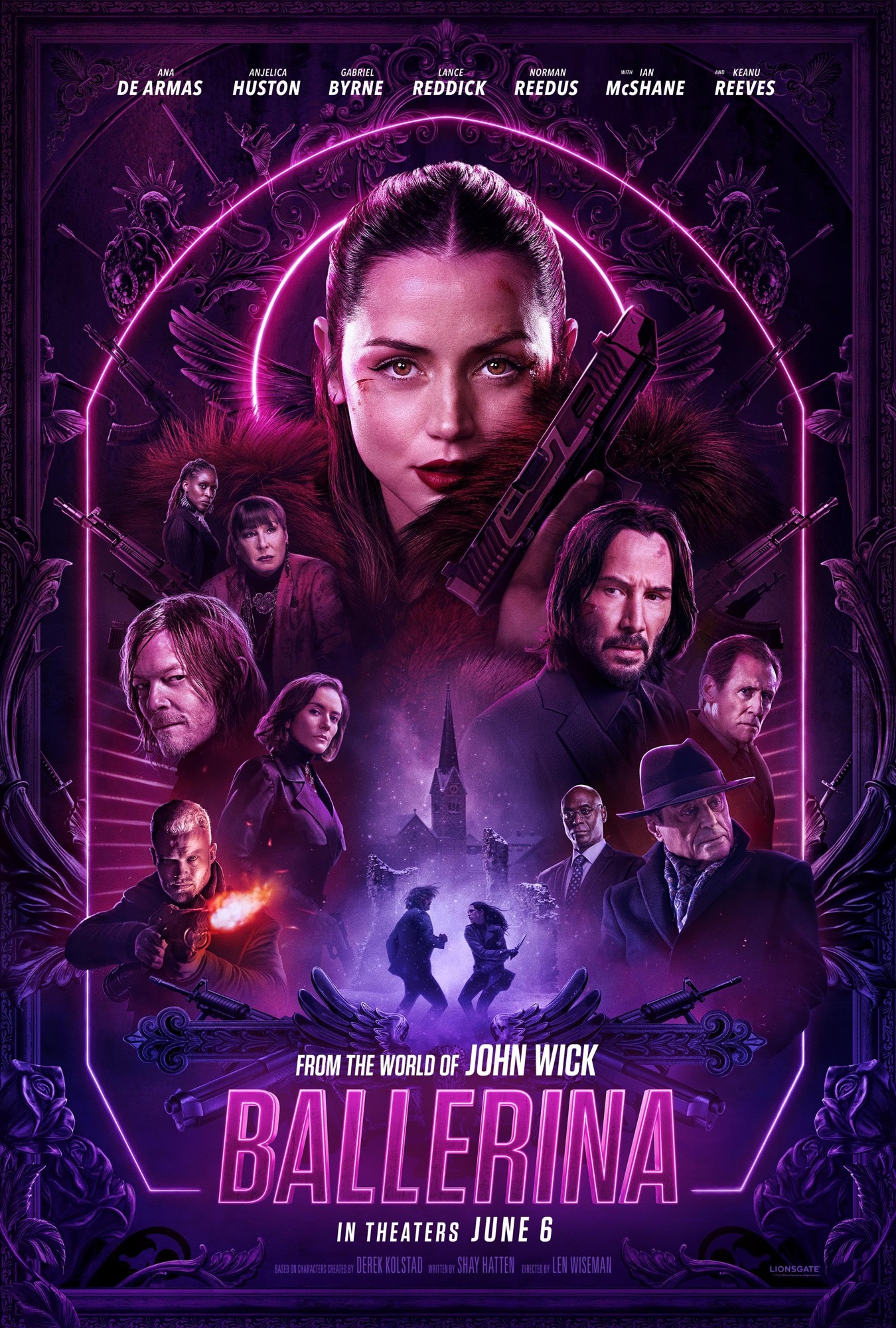


Ana de Armas steps into the neon-lit underworld with a commanding presence in *Ballerina*, an expansion of the *John Wick* mythos that leans into the franchise’s signature style while attempting to carve out its narrative space. Directed by Len Wiseman, the film balances its brutal action with moments of introspection, though it occasionally struggles to differentiate itself from its predecessors. As an assassin trained in ballet and bloodshed, de Armas delivers a graceful and ferocious performance, making her an undeniable force on screen.

The film picks up after the events of *John Wick: Chapter 3 – Parabellum*, following Rooney, a highly skilled ballerina-assassin seeking revenge for the murder of her family. Her quest leads her into the familiar corridors of the Ruska Roma, the secretive organization that has long operated in the shadows of Wick’s world. With glimpses of familiar faces, including Keanu Reeves in a brief but meaningful appearance, the film intertwines its new story with the established lore while ensuring that Rooney’s arc remains at the forefront.

De Armas carries the weight of the film with remarkable poise. Her action sequences are fluid yet punishing, her movements precise, whether executing a pirouette or dispatching enemies with cold efficiency. Unlike John Wick’s stoic demeanor, Rooney possesses a simmering emotional intensity, a raw vulnerability that underscores her drive for vengeance. The film allows space for her quiet moments of grief and reflection, ensuring that she is not merely an extension of Wick but a character with her motivations and struggles.

Wiseman’s direction effectively captures the franchise’s sleek, brutal elegance. While his visual approach remains consistent with Chad Stahelski’s signature neon-lit noir, he brings a slightly softer, more balletic aesthetic to the action. The fight choreography is exceptional, blending the dance-like precision of Rooney’s movements with the gritty impact of close-quarters combat. However, there are moments where the film plays too closely to its predecessor’s formula, occasionally feeling like an extension rather than a reinvention.

Thematically, *Ballerina* explores the familiar motifs of revenge, destiny, and the cyclical nature of violence. Rooney’s journey echoes John Wick’s in several ways but introduces the notion of artistry as both a weapon and a means of self-expression. The juxtaposition of ballet and brutality highlights the paradox of her existence—a woman trained to perform but shaped to kill. There are hints of deeper themes regarding autonomy and the cost of survival, though the film doesn’t always delve as deeply into them as it could.

Supporting performances add texture to the film, with Anjelica Huston reprising her role as the formidable Director of the Ruska Roma. She remains an imposing figure, offering cryptic guidance to Rooney while reinforcing that no assassin truly escapes their past. Gabriel Byrne and Lance Reddick provide understated gravitas to their respective roles, lending weight to the network of power and alliances that Rooney must navigate. However, some secondary characters feel underdeveloped, serving more as plot devices than fully realized individuals.

The film’s pacing falters slightly in the second act, as Rooney’s journey occasionally loses momentum in favor of extended world-building. While the *John Wick* universe is undeniably rich with lore, *Ballerina* sometimes lingers too long on exposition-heavy scenes that detract from its otherwise sharp energy. When the film refocuses on Rooney’s mission, it regains its urgency, culminating in a thrilling, elegantly choreographed climax that solidifies her as a worthy addition to the franchise’s deadly protagonists.

As an expansion of the *John Wick* universe, *Ballerina* maintains the stylish brutality and intricate world-building that fans expect. However, it doesn’t stray far from the established formula, and those hoping for a significant deviation may find its familiar beats limiting. That said, Ana de Armas’ commanding performance and Wiseman’s fluid action sequences make it a compelling watch, even if it never quite surpasses the kinetic brilliance of its predecessors.

The film is a visually stunning, well-executed entry that honors its roots while taking tentative steps toward originality. While it doesn’t redefine the genre, it does provide an intriguing perspective on assassins and retribution. If nothing else, it proves that vengeance remains an art form—and Rooney is an artist well worth watching.

**Grade: B+**


Leave a Reply