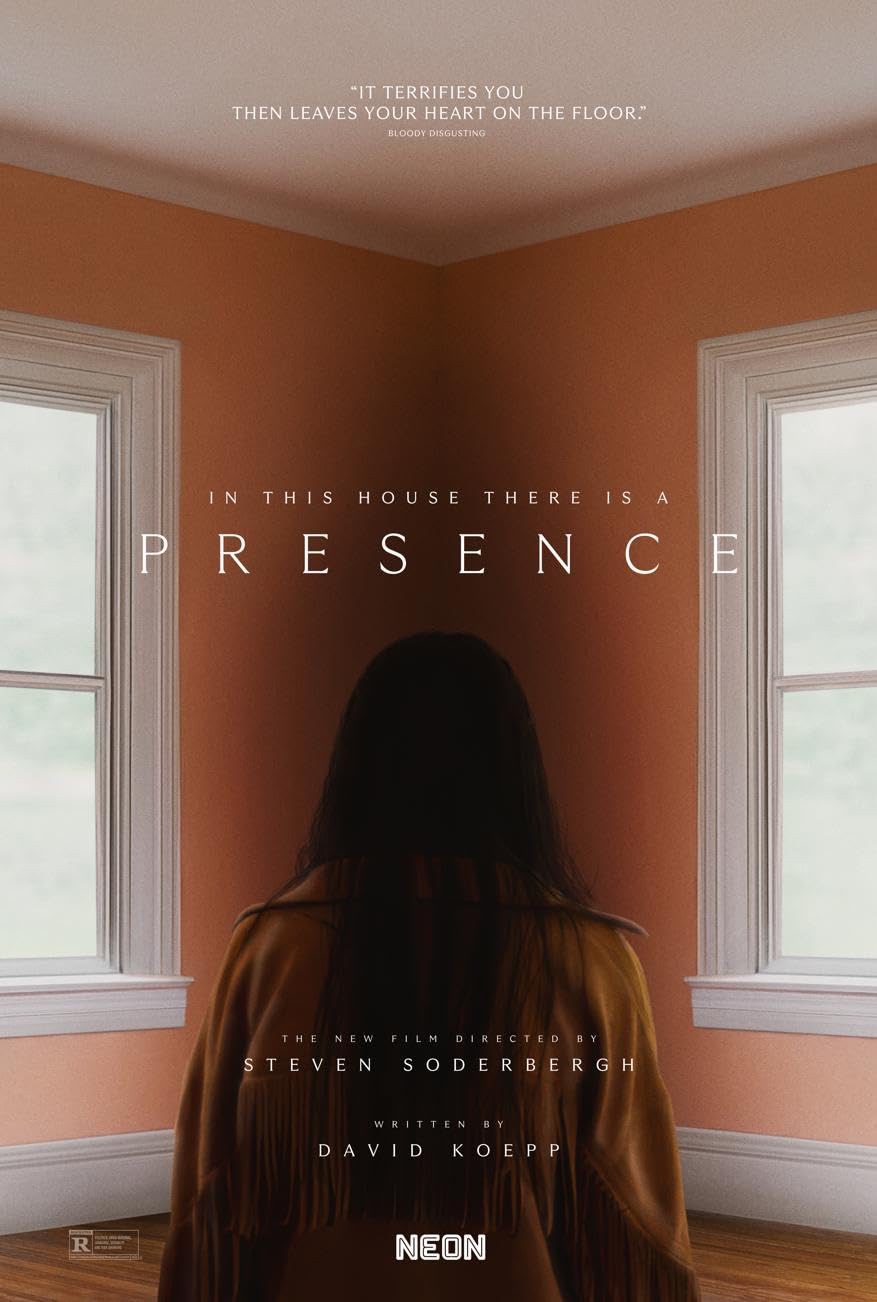


Steven Soderbergh’s *Presence* is an unnerving exercise in immersive horror, making the audience complicit in the unfolding dread. Told entirely from a first-person perspective, the film forces viewers into the role of the unseen force inhabiting a family’s new home, watching them as they slowly unravel under its influence.

Lucy Liu anchors the film as Rebekah Payne, a mother holding her family together with quiet resilience. Her tender but restrained interactions hint at an emotional exhaustion predating supernatural disturbances. She is a woman who has learned to compartmentalize, to keep her vulnerabilities hidden even from those closest to her. This emotional distance makes her an intriguing protagonist whose unraveling is as psychological as it is supernatural. Chris Sullivan plays her husband, Chris, a pragmatic skeptic whose disbelief fractures as the strange occurrences escalate. His arc is of reluctant acceptance, a slow erosion of certainty that mirrors the film’s creeping dread. Their children, played by Callina Liang and Eddy Maday, respond to the presence differently—Chloe with fearful avoidance and Tyler with unnerving curiosity. Tyler’s fascination with the entity hints at something darker, a subconscious recognition of his past cruelty.

The film explores themes of surveillance, intrusion, and unseen forces shaping reality. Soderbergh argues that horror is not just in what we see but in what sees us. The entity’s presence is never fully defined—it lurks constantly, shaping the family’s interactions and decisions. This ambiguity enhances the existential horror of the film, tapping into fears of control, privacy, and powerlessness. Tyler’s journey is particularly compelling in this regard. As the story unfolds, it becomes clear that he is present, reliving his past mistakes and coming to terms with his cruelty. His journey mirrors the idea that accurate understanding often comes too late, forcing him to confront his past actions from a detached, spectral perspective.

Soderbergh’s cinematography is both a technical feat and a narrative device. Shot entirely from the presence perspective, the film eliminates traditional framing techniques. There are no reverse angles, no establishing shots, and no moments where the audience is given a comfortable distance from the unfolding events. Instead, the camera drifts through rooms and lingers over private moments, mimicking the presence itself—a voyeur with no face, no motive, only a relentless awareness [This approach creates a suffocating intimacy, making the audience feel like an intruder rather than a passive observer. The film’s sound design reinforces this tension; creaks in the walls, disembodied murmurs, and moments of eerie silence become storytelling devices in their own right.

The absence of traditional horror beats—no dramatic jump scares, no expository flashbacks—allows *Presence* to thrive on unease. Soderbergh’s disruption of genre conventions is largely effective, though it may frustrate viewers expecting a more conventional horror experience. The film’s horror is not about sudden shocks but the slow erosion of certainty, the creeping realization that something is watching, waiting, and influencing. This restraint makes *Presence* a uniquely unsettling experience that lingers long after the credits roll.

Streaming now on Hulu, “Presence” is a testament to Soderbergh’s ability to transform cinematic form into a psychological experience.

**Grade: A-**


Leave a Reply