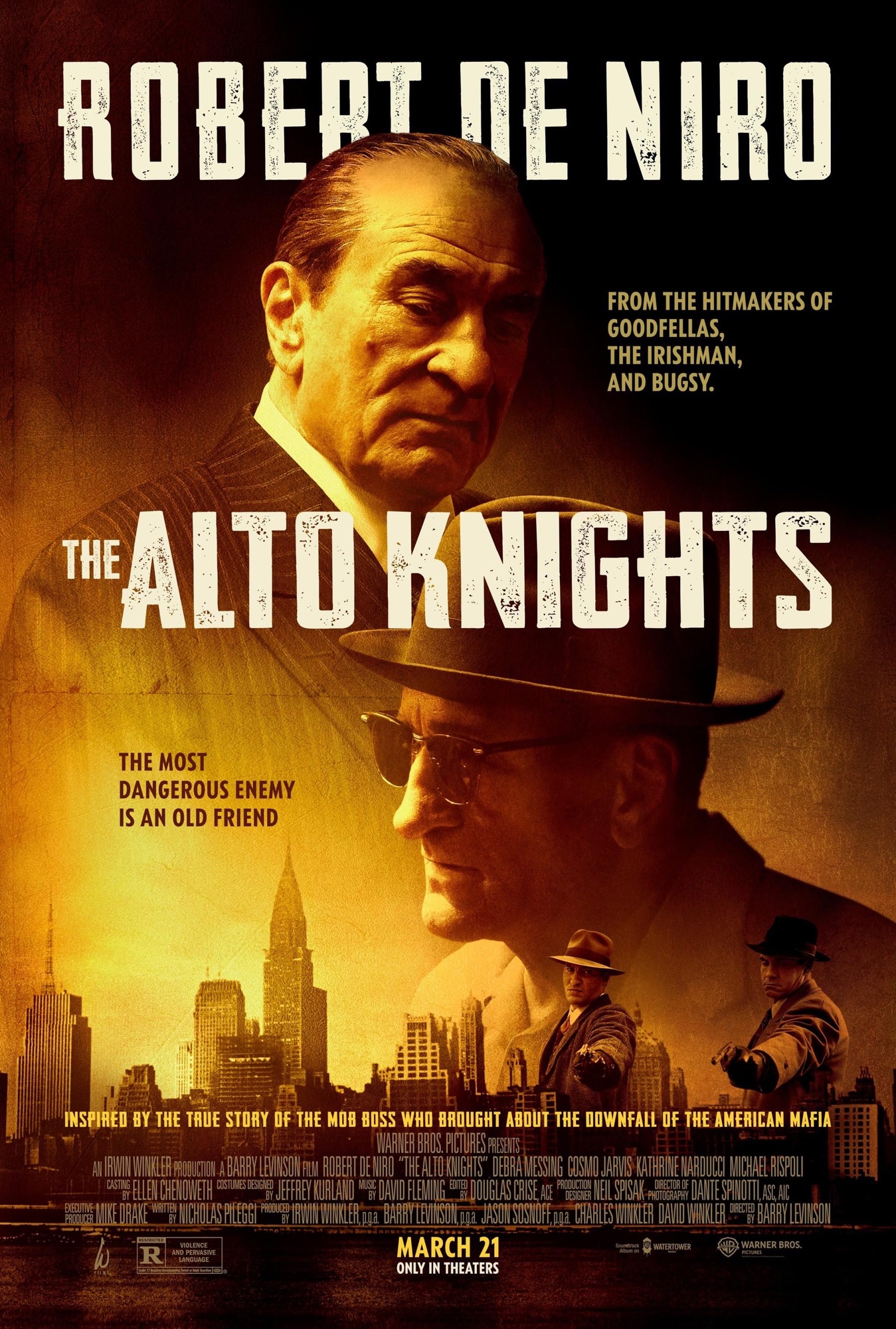


The criminal underworld has always been a rich source of inspiration for films. However, expectations can become a double-edged sword when two legendary figures come together. Barry Levinson’s *The Alto Knights*, featuring Robert De Niro in dual roles, offers an ambitious exploration of fraternal bonds complicated by power, greed, and betrayal. The film is suspenseful and atmospheric, balancing gripping tension with familiar elements reminiscent of De Niro’s previous performances. Ultimately, it serves as a bold crime saga and a testament to its limitations.

The story unfolds like smoke curling from the muzzle of a gun. De Niro portrays two brothers: Vincent, the stoic and calculating elder whose touch chills even when it appears kind, and Joey, the reckless and charming provocateur who is more spark than flame. When their father’s legacy—once rooted in quiet loyalty within their mob syndicate—becomes fractured by their conflicting leadership styles, the stage is set for a Shakespearean unraveling. Levinson, known for his skillful portrayal of interpersonal dynamics, delivers moments of intense intimacy. Conversations between Vincent and Joey simmer with unspoken resentments, filled with pauses that stretch like taut piano wires.

Levinson’s narrative occasionally struggles under the weight of its duality. While De Niro convincingly portrays two distinct personalities, the structural demands of a dual-character film tend to slow the pace. Some scenes, which are meant to serve as pivotal moments of connection between the brothers, come across as contrived; they feel more like reiterations than revelations. However, *The Alto Knights* excels in its atmospheric mastery. Levinson creates a world filled with dimly lit restaurants, where cigarette smoke mingles with amber lights and the creaking wooden floors of old mob strongholds, each frame whispering secrets and evoking a sense of dread.

De Niro’s performance in dual roles is a bold challenge, and for the most part, he meets it successfully. Vincent’s cold demeanor contrasts sharply with Joey’s lively bravado, creating a dichotomy that keeps the audience questioning how much the two share beneath the surface. However, while De Niro skillfully portrays both characters, the film’s focus on symmetry sometimes weakens the drama. The back-and-forth exchanges between the brothers can feel overly orchestrated, which takes away from the spontaneity of moments that could have elicited more profound emotional responses.

As a crime saga, *The Alto Knights* may not redefine the genre, but it holds its ground. Levinson infuses the film with echoes of his earlier successes—moments of humanity reminiscent of *Rain Man* but combined with the darker, sharper edges of *Bugsy.* However, the film fails to fully capitalize on the fraternal dynamic, leaving it short of greatness. While the intrigue is present and the themes are rich, the resolution feels too tidy and lacks the jagged edges that often make crime stories genuinely unforgettable.

In the pantheon of De Niro’s legendary performances, *The Alto Knights* may not overshadow classics like *Goodfellas* or *Taxi Driver,* but it still showcases his enduring talent. Despite the limitations of a somewhat uneven script, his ability to bring depth to two characters is nothing short of remarkable. While Levinson’s direction is commendable, it lacks the sharpness found in his best works, such as *Diner* and *Wag the Dog.*

Ultimately, The Alto Knights stand out as a film that reflects its creator’s strengths and occasional uncertainties. The intertwined stories of Vincent and Joey are filled with potential. While Levinson’s execution does not always align with the film’s ambitious goals, the moments that do connect create a tapestry of suspense and sorrow that is worth experiencing.

Whether *The Alto Knights* is a significant addition to Levinson’s catalog or merely a footnote in De Niro’s illustrious career depends on your willingness to embrace the familiar. Perhaps this is the film’s core: it casts such enticing shadows that the fleeting moments of light leave you longing for what could have been.

*Grade: B+*


Leave a Reply