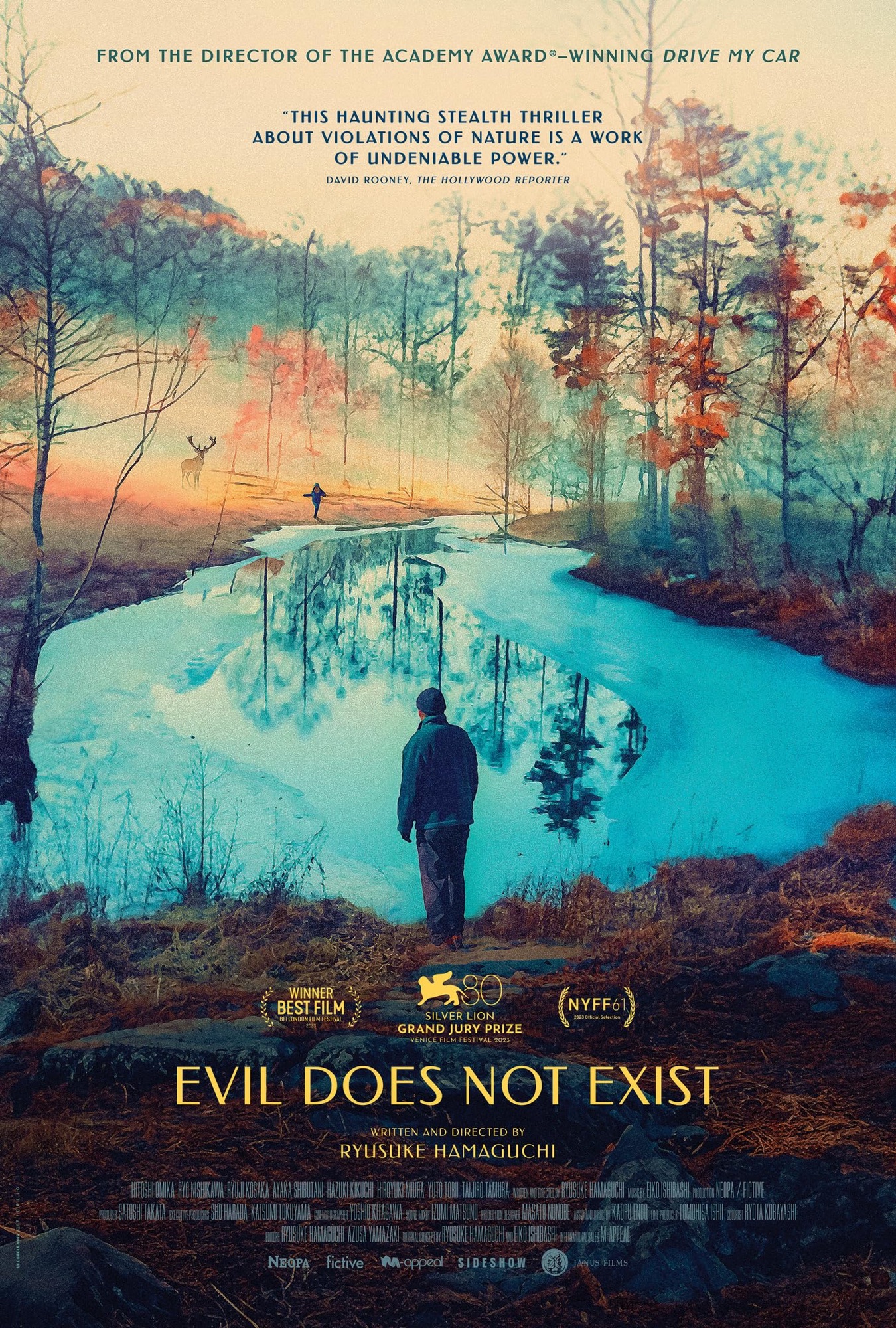

In the rural alpine hamlet of Mizubiki, not far from Tokyo, Takumi and his daughter, Hana, lead a modest life gathering water, wood, and wild wasabi for the local udon restaurant. Increasingly, the townsfolk become aware of a talent agency’s plan to build an opulent glamping site nearby, offering city residents a comfortable “escape” to the snowy wilderness. When two company representatives arrive and ask for local guidance, Takumi becomes conflicted in his involvement, as it becomes clear that the project will have a pernicious impact on the community. Ryusuke Hamaguchi’s follow up to his Academy Award®-winning DRIVE MY CAR is a foreboding fable on humanity’s mysterious, mystical relationship with nature. As sinister gunshots echo from the forest, both the locals and representatives confront their life choices and the haunting consequences they have.
REVIEW:

Ryûsuke Hamaguchi’s latest film, “Evil Does Not Exist,” is a profound exploration of humanity’s relationship with nature and the concept of evil. The film’s title is a bold statement that is intricately woven into the plot and characters, ultimately suggesting that evil is not inherent in nature but rather a construct of human consciousness.

The story follows Takumi, a widower living a simple, harmonious life with his daughter Hana in a rural village near Tokyo. Their peaceful existence is threatened by a corporate plan to build a glamping resort, which promises to disrupt the natural balance of their community. Takumi’s interactions with the corporate representatives highlight the clash between modern civilization and the untouched beauty of nature.

Hamaguchi masterfully uses the characters to reinforce the film’s central theme. Takumi embodies the purity and resilience of nature, while the corporate representatives symbolize the intrusion of human greed and ambition. The film’s serene and poetic cinematography further emphasizes the stark contrast between the untouched wilderness and the artificiality of human endeavors.

The ending of “Evil Does Not Exist” is both haunting and thought-provoking. As the corporate plan begins to unravel, the film leaves viewers with a sense of ambiguity, reflecting the complex nature of human morality. The final scenes suggest that while nature remains indifferent and pure, it is human actions and intentions that introduce the concept of evil.

Compared to Hamaguchi’s previous works, such as “Drive My Car,” “Evil Does Not Exist” delves deeper into the philosophical and existential themes. While “Drive My Car” focused on personal grief and healing, this film broadens the scope to examine humanity’s impact on the natural world. Both films, however, share Hamaguchi’s signature style of nuanced storytelling and richly developed characters.

Overall, “Evil Does Not Exist” is a beautifully crafted film that challenges viewers to reflect on the nature of evil and our place in the world. Streaming now on the Criterion Channel, it is a must-watch for fans of thought-provoking cinema. I would give it a grade of B+ or 3.5/5 for its compelling narrative and stunning visuals.

CREDITS:
Directed by
Written by
Ryusuke Hamaguchi
Produced by
Satoshi Takata[1]
Starring
- Hitoshi Omika
- Ryo Nishikawa
- Ryuji Kosaka
- Ayaka Shibutani
Cinematography
Yoshio Kitagawa[1]
Edited by
Music by
Production
company
NEOPA Inc.[1]
Distributed by
Incline
Release dates
- 4 September 2023(Venice)
- 26 April 2024(Japan)
Running time
106 minutes[1]
Country
Japan
Language
Japanese


Leave a Reply