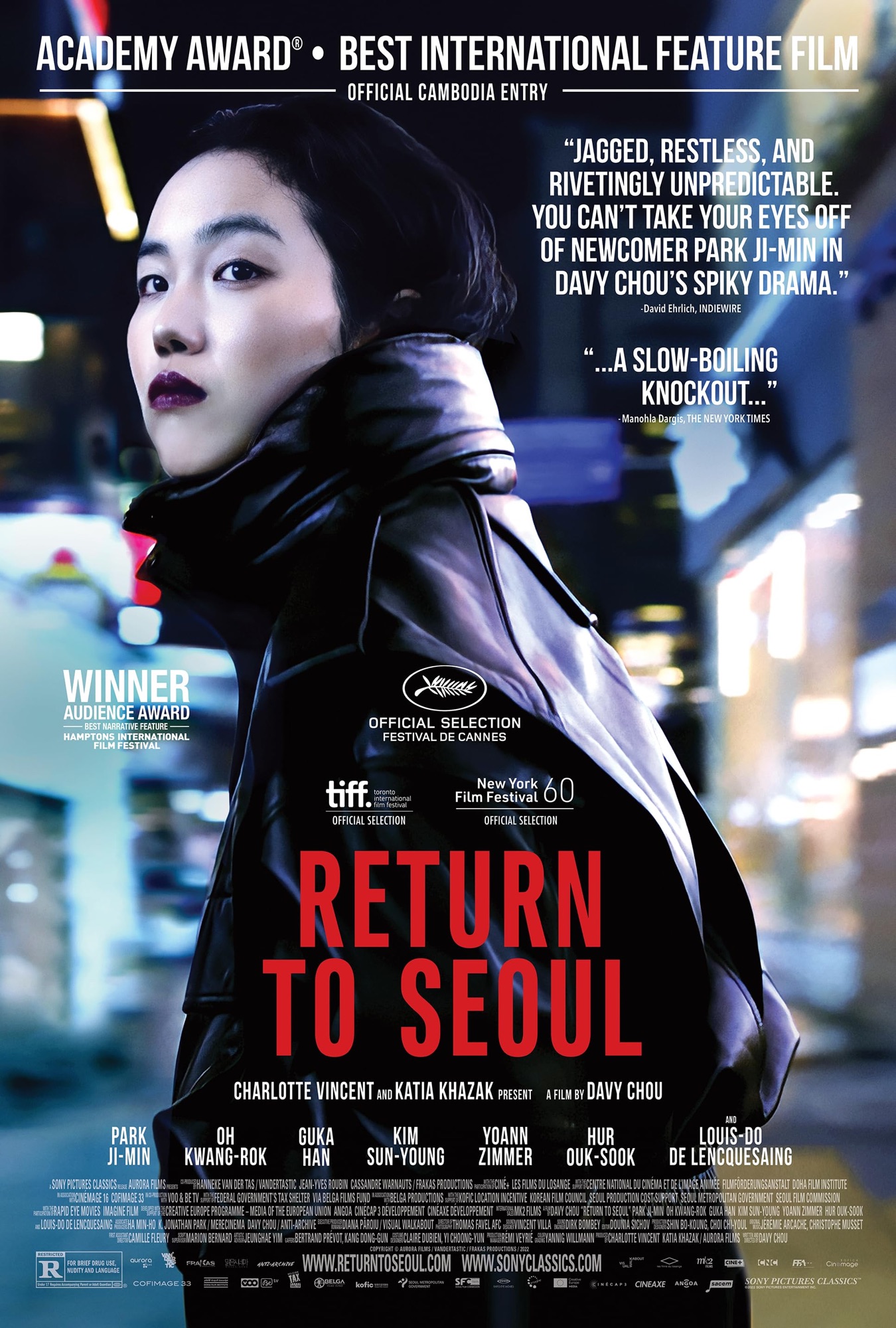

MOVIE INFO VIA ROTTEN TOMATOES:
On an impulse to reconnect with her origins, Freddie, 25, returns to South Korea for the first time, where she was born before being adopted and raised in France. The headstrong young woman starts looking for her biological parents in a country she knows so little about, taking her life in new and unexpected directions.

Return to Seoul is all about the dislocation a Korean adoptee- Freddie Benoit (newcomer Park Ji-Min delivering an exceptional performance) feels when she on a whim decides to fly to Seoul and look for her birth parents. Freddie was born in South Korea but was adopted by a French couple. She was raised in Paris, so speaks only French. In Seoul she blends in uncomfortably. She doesn’t want to be a part of Korean culture, but is forced to because of her appearance. She rebels against this by deliberately breaking expected drinking rituals and other customs

Freddie expresses the feeling of most foreign adoptees. She’s never truly comfortable in her adopted country or her native one. Never comfortable anywhere or even with herself. Yet in Korea she’s is found fascinating. Over the years that encompass the story she has relationships with a bookish hotel clerk (Guka Han), an enamored nerd who wants her long term (Kim Dong-Seok), a grimy tattoo artist (Lim Cheol-Hyun), a French international arms dealer twice her age (Louis-Do de Lencquesain)

Freddie decides to stay in Korea, cynically adopting the language and customs but never making any real connections. She moves through styles and morphing personalities from Tomboy to glamour punk to wellness drone. She is constantly annihilating herself by adopting and discarding people and everything she finds toxic.

In a way, this is the director’s Davy Chou’s story. Chou was born in France, the grandson of a Cambodian film producer who vanished in 1969 as the Khmer Rouge began to seize control. He understands the dislocation and the contradictions in Freddie’s character. How as an adoptee she has been deprived of a life she doesn’t want to live or can’t really fit into.

The search for Freddie’s birth parents has her entangling herself in the Korean adoption bureaucracy. It just makes her further frustrated and dislocated. When she learns that her true name is Yeon-hee, docile and joyful in Korean, it’s like a cruel joke, a bitter twist of fate. She is neither of those. She is left wondering if her birth parents clearly ever knew her at all.

Freddie’s scenes with her father (Oh Kwang-Rok) are masterpieces of dislocation and angst. The only thing father and daughter truly share is acting out when drunk. Their time together only seem momentous but are aggressively dull and awkward- silent, remorseful lunches, boring drives to childhood touchstones, stilted conversations that need a translating intermediary and are so tinged with heavy remorse that it strikes Freddie as pushy, paternalistic atonement, like she’s an animal that is being caged. Everything is polite, traditional. Frankness is impossible because it can’t bridge the intermediaries needed for the language and cultural gap.

The saving grace for Freddie is music. It’s the one thing that bridges all the miscommunications. When she uninhibitedly dances to Korean Disco, listens to her father’s piano recording and then, in the final scene, sight reading and performing music that comes beautifully together on a hotel piano, she is finally and fully connected. I felt happy for her.

Return to Seoul gets a 4/5 or an A-. It’s streaming on Amazon Prime.

CREDITS:
Retour à Séoul
Directed by
Written by
Davy Chou
Produced by
- Charlotte Vincent
- Katia Khazak
Starring
- Ji-Min Park
- Oh Kwang-rok
- Guka Han
- Kim Sun-young
- Yoann Zimmer
- Hur Ouk-Sook
- Louis-Do de Lencquesaing
Cinematography
Thomas Favel
Edited by
Dounia Sichov
Music by
- Jérémie Arcache
- Christophe Musset
Production
companies
Distributed by
- Les Films du losange (France)
- Rapid Eye Movies (Germany)
- Imagine Film Distribution (Belgium)
- Sony Pictures Classics (North and Latin America, Middle East, Australia and New Zealand)
- Westec Media Limited (Cambodia)
Release dates
- 22 May 2022(Cannes)
- 18 November 2022(Cambodia)
- 25 January 2023(France)
- 26 January 2023(Germany)
- 8 February 2023(Belgium)
Running time
119 minutes[1]
Countries
- France
- Germany
- Belgium
- Qatar
- Cambodia
Languages
- French
- Korean
- English


Leave a Reply