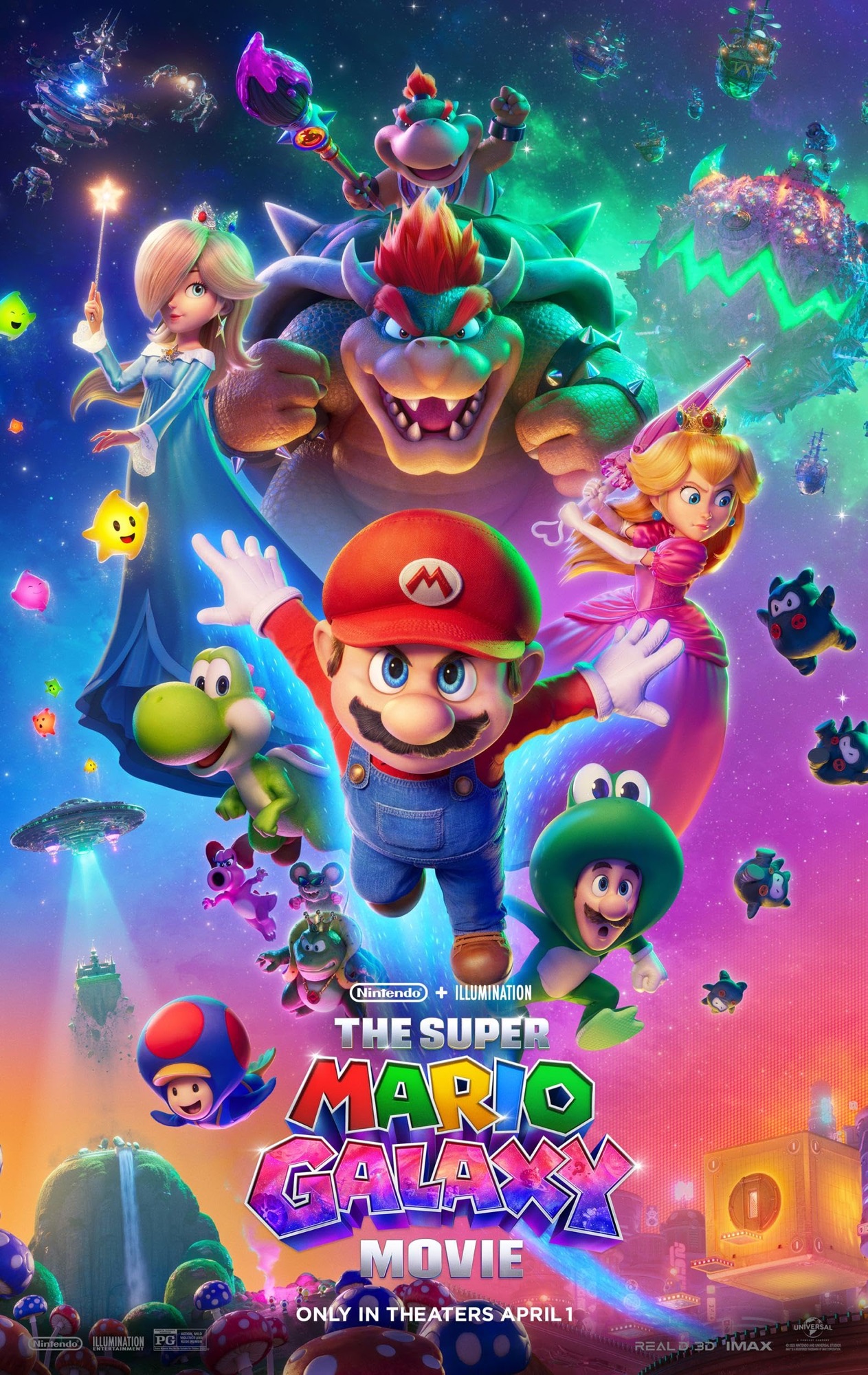


The Super Mario Galaxy Movie opens with a burst of color and confidence, plunging straight into its cosmic swirl without a whisper of recap. It’s gutsy to leap into a sequel without reminding the audience who these characters are, or why Bowser is still pocket‑sized and pacing a tiny castle. The film trusts that viewers will either remember or simply roll with it, and that trust becomes both a playful dare and a structural wobble.

Perhaps the creators expect most viewers to be fluent in the Mario universe already. The film behaves as though the lore is a shared language, one that needs no translation. That assumption frees the directors—Aaron Horvath, Michael Jelenic, and Pierre Leduc—to sprint through galaxies, but it also leaves newcomers blinking at the starfields, searching for footing.

Or maybe they believe it doesn’t really matter, because the plot is not exactly the point of Super Mario Galaxy. It is merely a vehicle designed to move us along from set piece to set piece and introduce new, fun, weird little guys. That becomes both its strength and its greatest liability, a tension the movie never fully resolves.

The game’s plot has been scrambled, presumably to preserve an element of surprise, though the core players remain: Mario (Chris Pratt), Peach (Anya Taylor‑Joy), Luigi (Charlie Day), Rosalina (Brie Larson), Bowser (Jack Black), Bowser Jr. (Benny Safdie), and a parade of supporting oddballs. Most of the story concerns chasing down things that have been stolen and discovering Who Your Real Friends and Family Are, the fallback lesson of every Hollywood children’s adventure. The film delivers this theme with earnestness, even when the pacing undercuts the emotional beats.

The best moments arrive whenever the characters land on a new planet or enter a new environment. Honeyhive’s golden chambers, Fossil Falls’ prehistoric cliffs, and the Comet Observatory’s serene glow each carry a spark of wonder. The directors know how to stage a reveal, and the animators know how to make a world feel freshly minted.

Still, there’s a flat empty nothingness to The Super Mario Galaxy Movie, even more than its flat empty predecessor, and that’s a huge bummer. The film races through its worlds without letting them breathe. The visual splendor is present, but the movie rarely pauses long enough for the audience to savor it.

Perhaps the bigger problem is inherent to the medium. If you’ve never played Super Mario Galaxy, it’s hard to explain how revolutionary it felt at the time. The game’s gravity‑bending mechanics and spatial inventiveness created a sense of discovery that no cutscene could replicate. The movie, bound to a single forward motion, can only gesture toward that sensation.

The Super Mario Galaxy Movie is just the opposite of its source’s expansiveness. There are audiences for whom pointing at the screen and saying “I know that reference!” is enough to feel engrossed, and they’ll likely be delighted. But many viewers—children included—want to feel absorbed in a film, which means being emotionally engaged with the characters and the stakes. This movie is overstuffed in a way that leaves little room for investment, and though its characters and worlds are witty, they barely get enough screen time to register.

Watching a movie is an inherently more passive activity than playing a game. You don’t get to make choices, pause, or linger. The creators make all of those decisions for you. Much of the joy of the Mario universe has always been its zany, whimsical visual humor, and that spirit still waits for a movie to match it. This film gets closer than the last one, but it still feels caught between honoring the game’s legacy and chasing the demands of a modern animated blockbuster.

And yet, the movie’s energy is infectious. Chris Pratt’s Mario carries a warm earnestness, Anya Taylor‑Joy’s Peach balances regality with steel, and Brie Larson’s Rosalina brings a gentle cosmic melancholy. The cast keeps the film buoyant even when the script thins. The result is a sequel that entertains, frustrates, dazzles, and occasionally exhausts, but never stops reaching for something bright.

LETTER GRADE: B.


Leave a Reply