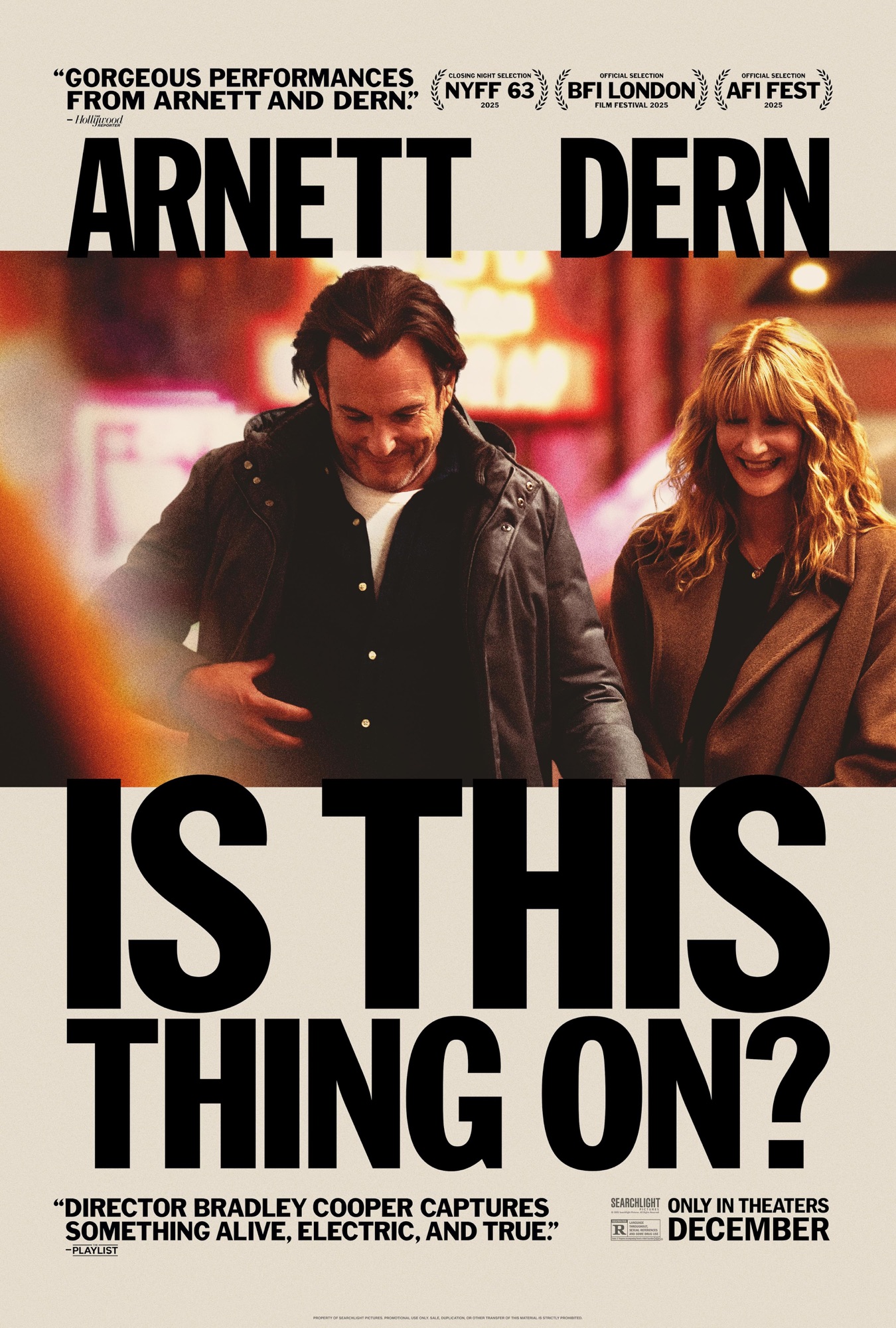


Bradley Cooper’s Is This Thing On? arrives with the shape of a familiar dramedy—marriage ending, identity wobbling, two people trying to remember who they were before the years stacked up—but it refuses to settle into the expected grooves. Cooper leans into the ache of midlife drift, then jolts the film forward with a comic energy that keeps the material from sinking. The result is a story that feels lived‑in and newly charged, a portrait of two people who discover that reinvention can be both humiliating and exhilarating.

Will Arnett’s Alex Novak becomes the film’s unstable center of gravity, and the movie is at its best when it treats his stand‑up routines as both confession and combustion. The title refers to the microphones he keeps grabbing at the Comedy Cellar, but it also points toward a deeper uncertainty: whether Alex is finally waking up or still drifting through the wreckage of his own choices. Cooper stages these sets with a rawness that exposes Alex’s desperation, then lets the humor punch through in jagged bursts. The comedy never erases the pain; it sharpens it.

Laura Dern’s Tess Novak gives the film its counterweight. Her return to volleyball, and the possibility of coaching in the 2028 Olympics, becomes more than a subplot. It’s a reckoning with the version of herself she abandoned. The film doesn’t reduce her to a foil for Alex’s crisis. Instead, it lets her grief over a lost athletic life sit beside her determination to reclaim something that once defined her. Dern plays Tess with a steadiness that deepens the film’s emotional stakes.

Arnett and Dern work in a register that resists melodrama. They convey anguish without drowning the film in sorrow, and their arguments carry the sting of long‑stored resentments. When Tess confronts Alex about the photo of her he hangs in his apartment, the moment lands with force because the film has already shown how easily partners can turn each other into symbols. Cooper’s direction keeps these scenes taut, refusing to let them drift into sentimentality.

Cooper himself, as Balls, becomes the film’s comic detonator. His performance as a perpetually dazed actor—never fully clear whether he’s high, dim, or both—injects the movie with a chaotic warmth. Balls’ own marital confusion mirrors Alex’s, but Cooper uses the character to expose the absurdity of self‑help epiphanies and the fragility of long‑term relationships. His scenes with Andra Day’s Christine add a welcome layer of domestic absurdity.

The film’s strongest throughline is its attention to the small erosions that accumulate in a marriage. Cooper shows how silence becomes its own form of neglect, how chores and childcare and exhaustion can bury affection. The dirty dishes and laundry aren’t metaphors; they’re the physical evidence of two people who stopped tending to each other. The movie never scolds them for it. It simply observes the slow drift with clarity.

Although Alex’s journey dominates the narrative, the film gives Tess enough space to reveal her own unraveling. Her scenes with Peyton Manning’s Laird—earnest, supportive, slightly awkward—highlight the gulf between what she wants and what she’s willing to admit. Her attempts to rebuild a life outside marriage feel grounded, not performative. The film treats her ambition with respect, acknowledging the cost of letting go of a past that once defined her.

As Alex and Tess begin to imagine futures that no longer orbit each other, the movie raises a question that lingers long after the credits: were they undone by the marriage, or by themselves? Cooper refuses to offer a clean answer. Instead, he lets the characters stumble toward clarity, sometimes through stand‑up rants, sometimes through sex, sometimes through the bewildering advice of Alex’s father Jan, played with weary authority by Ciarán Hinds.

The supporting cast enriches the film’s texture. Amy Sedaris’ emcee at the Comedy Cellar brings a sharp edge to the club scenes. Jordan Jensen and Chloe Radcliffe, as fellow comics, give the stand‑up world a lived‑in authenticity. The subplot involving Balls and Christine, and their mutual decision to embrace confusion, becomes a sly commentary on the impossibility of tidy emotional resolutions.

By the time Alex and Tess reunite at their sons’ school performance of “Under Pressure,” the film has earned its hopeful ending. The kiss doesn’t promise a perfect future. It acknowledges the work ahead. Cooper’s film thrives on that tension: the recognition that love can survive only when both people stop performing and start listening. Is This Thing On? may be a midlife dramedy, but it pulses with a freshness that makes its familiar beats resonate.

LETTER GRADE: B. On Hulu.


Leave a Reply