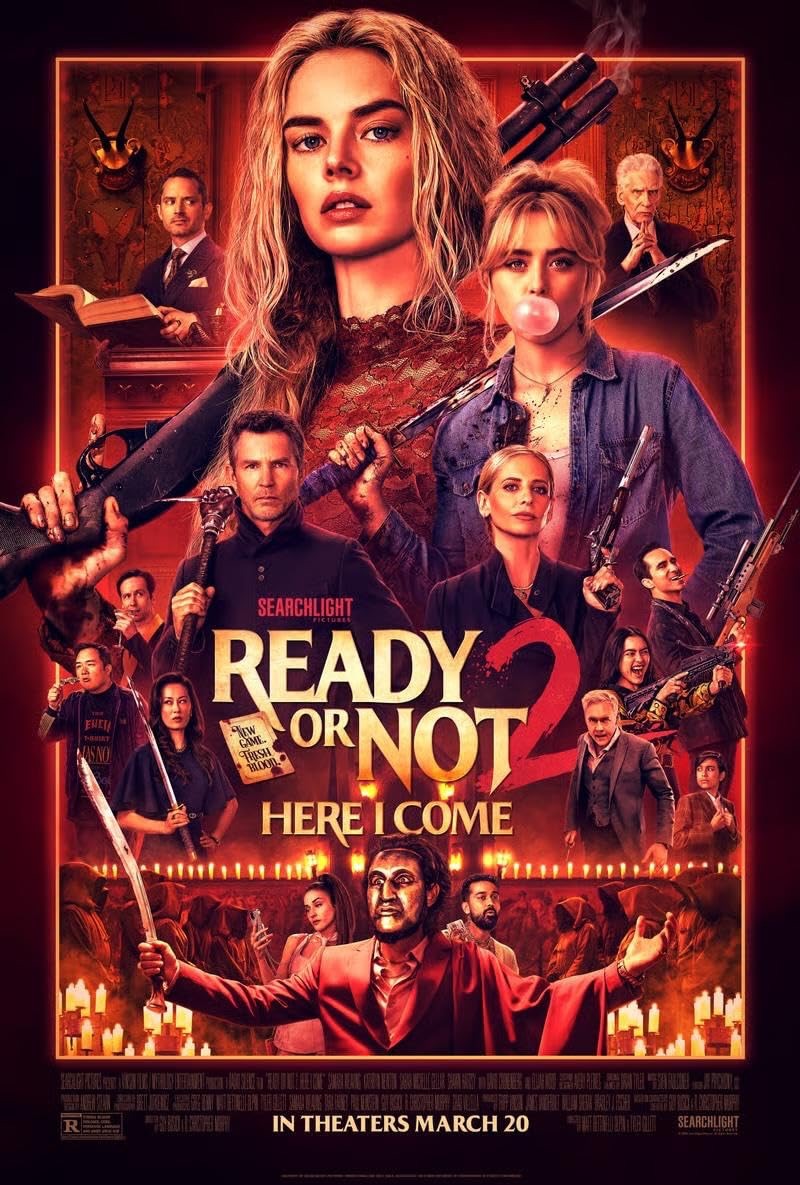


“Ready or Not 2: Here I Come” arrives with the confidence of a sequel that knows exactly what kind of blood-soaked circus it wants to be. The first film helped cement the current wave of “eat the rich” entertainment, a mode of storytelling that has thrived for reasons that are hardly mysterious. This follow‑up leans into that appetite with a sharper edge, a broader canvas, and a willingness to push its own absurdity until it buckles under the weight of its ambition.

The film wastes no time expanding the mythology. Grace MacCaulley’s escape from the Le Domas estate has made her a target for a larger, older, and far more deranged network of elites. The Council’s arrival at the Danforth resort turns the sequel into a sprawling hunt, but the escalation isn’t just about scale. It’s about exposing how deep the rot goes. The script by Guy Busick and R. Christopher Murphy embraces an inherent silliness that hovers between medieval fable and conspiracy theory, yet the tone never drifts into parody for its own sake. Every grotesque twist serves the film’s larger point: these families have been devouring the world for generations.

Samara Weaving carries the film with a performance that blends wounded resolve with a ferocity that feels earned. Grace has survived the impossible once, and the sequel understands that trauma doesn’t vanish just because the plot demands momentum. Kathryn Newton’s Faith enters the story as a counterweight, a younger sister who has her own scars and her own anger. Their dynamic gives the film its emotional spine. Newton brings a grounded toughness that deepens the stakes, and the scenes where the sisters clash and reconcile give the carnage a human pulse.

The supporting cast is intentionally thin, but that’s part of the design. Sarah Michelle Gellar’s Ursula Danforth, Shawn Hatosy’s Titus, David Cronenberg’s Chester, and the rest of the Council aren’t meant to be fully dimensional. They’re embodiments of entitlement, cowardice, greed, and misogyny. The film treats them as types because the story doesn’t need them to be anything more. Their purpose is to reveal how power calcifies into something monstrous.

The violence pushes past the cartoonish tone of the first film and lands in territory that feels uncomfortably graphic. The escalation works because it mirrors the moral decay of the hunters. Their rituals, their rules, their obsession with the High Seat ring—everything points to a worldview that has hollowed them out. By the time bodies explode across the resort grounds, the film makes clear that the danger isn’t just their wealth or their influence. It’s the spiritual rot that has consumed them.

The humor remains broad and gleefully deranged. People sprinting for cover moments before spontaneous combustion shouldn’t be funny, yet the film leans into the absurdity with a frantic energy that pays off. The zaniness never undercuts the horror. Instead, it heightens the sense that the Council’s world is collapsing under its own grotesque logic.

The plot’s reinventions keep the sequel from feeling like a retread. The loophole involving marriage, the casino showdown, the washing‑machine kill, the shotgun reversal, and the final descent into the underground altar all twist the familiar structure into something unpredictable. Even the last‑minute wedding between Grace and Titus feels both ludicrous and inevitable, a culmination of the film’s obsession with ritual and power.

The climax delivers a payoff that matches the film’s escalating madness. Grace’s decision to stab Titus and claim the High Seat only to reject it outright reframes the story’s central conflict. This isn’t just about eating the rich anymore. It’s about stopping them from consuming everyone else. The final blood explosion, the collapse of the Council, and Le Bail’s silent acknowledgment give the ending a mythic charge without drifting into sentiment.

The closing image of Grace and Faith walking away together gives the film its one moment of calm. It’s not a sentimental gesture. It’s a promise forged in blood and exhaustion, a recognition that survival means nothing if you walk away alone.

LETTER GRADE: B+.


Leave a Reply