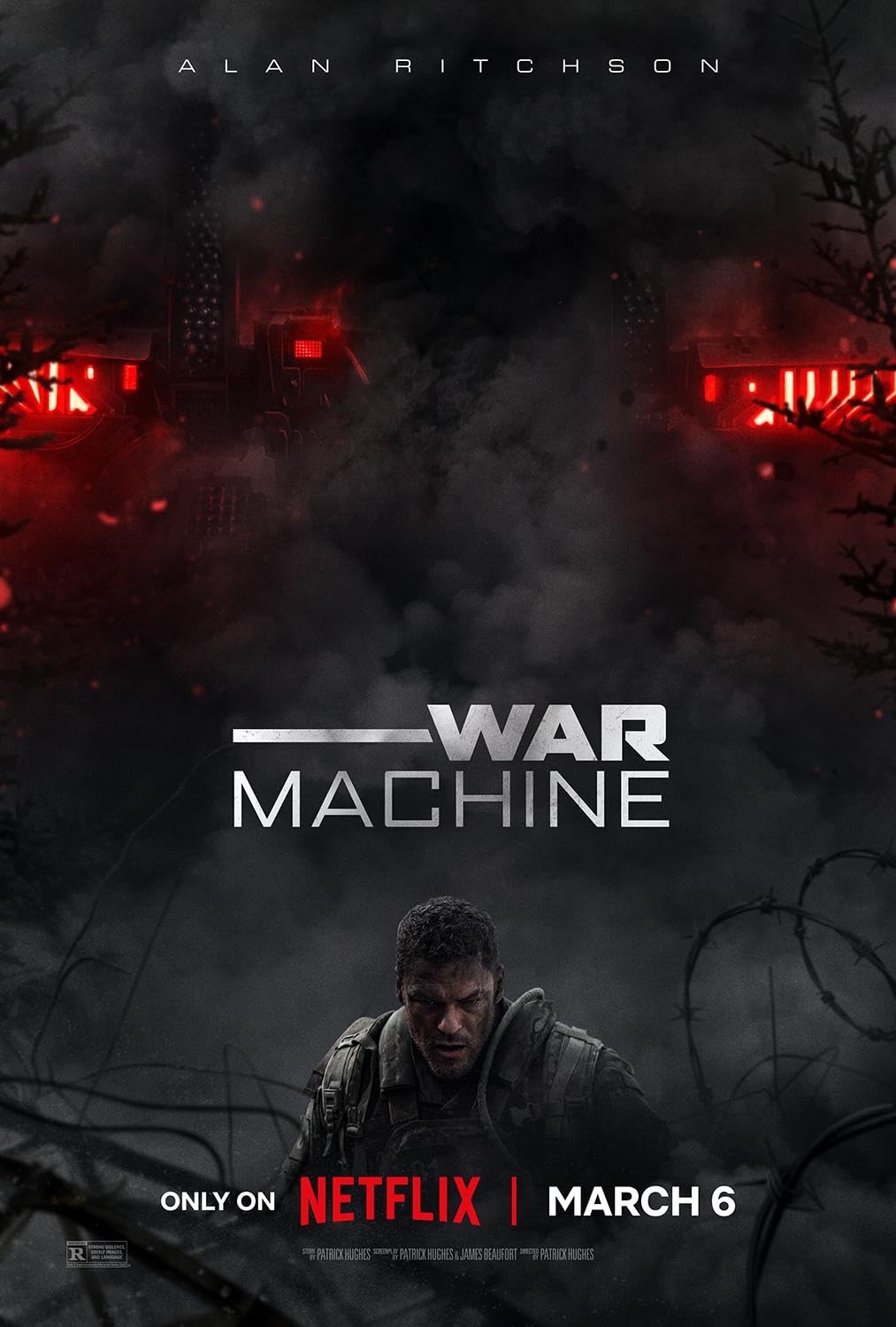


A soldier’s remorse manifests in War Machine, Patrick Hughes’s intense sci-fi action film featuring Alan Ritchson’s steady presence. The story begins in Afghanistan, where a Staff Sergeant joins his brother’s convoy that’s stuck. When an ambush erupts, it devastates the team with harsh precision, leaving only the Staff Sergeant standing and burdened with a Silver Star he never sought.

Two years later, he joins the Ranger Assessment and Selection Program in Colorado. The film then shifts into a long series of physical challenges: mountain runs, cliff descents, underwater drills that push him toward self-erasure. Ritchson’s 81 moves through these trials with a reserved intensity that suggests a man trying to outrun his own pulse.

The recruits surrounding him seem like a loose constellation of potential connections, each one adding to the feeling of possibility. Stephan James’s 7 reaches out to him with a steady, principled confidence that breaks through the cold formality. Dennis Quaid’s Sheridan looks at 81 with suspicion, as if sensing a fracture beneath the strict discipline. Esai Morales’s Torres attempts to understand the man behind the number but finds only a locked door, leaving him puzzled.

The final training exercise takes the team into more challenging territory. They head into the forest to neutralize a secret aircraft and save its pilot. The object they encounter seems to defy all earthly logic. Their explosives simply bounce off its surface. When it transforms into a walking machine, the simulation quickly turns into a brutal encounter.

The survivors—81, 7, 15, 44, 109, and 23—continue their journey downriver, despite their compasses being warped by the machine’s magnetic field. They discover that the cadre meant to oppose them has already been reduced to debris. The scars on the mountain’s impact reveal the machine’s alien origin. The chase toward the APC turns into a frantic rush to find any possible advantage.

The APC sequence stands out as one of the most powerful parts of the film. The presence of live ammunition gives a brief glimmer of hope, though the machine’s armor protects it from harm. A rockslide provides a fleeting chance of survival, not victory. When the APC explodes, only 81 and 7 remain alive. Their escape into the forest takes the story into its emotional heart, drawing viewers deeper into its emotional core.

In 7, it’s revealed that he knew 81’s brother, which adds a new layer of depth to the story. The scene where the machine sends a signal into the sky, calling its own, feels like a pivotal moment. As 81 examines its ventilation system and transforms the environment into a weapon, the construction site becomes a tense, almost crucible-like setting. Rocks pouring into the vents and the machine overheating lead to a satisfying but not overly triumphant explosion, making the climax feel earned and impactful.

The ending takes on a broader perspective, showing how the stakes are global. Sheridan and Torres excitedly reveal that what they thought was a simple asteroid is actually an army of machines. The invasion is now underway, and 81’s discovery of their weakness opens the door for him to join the Regiment. The story places him right at the forefront of the upcoming attack, as a man who has been reshaped through fire and metal, ready to face the challenge ahead.

War Machine may use straightforward metaphors and a tough perspective, but it provides a strong, emotionally charged experience. Ritchson’s performance keeps the film engaging, while James brings it to life. The action scenes hit hard, and even though the ending might feel a bit like recruitment propaganda, the overall journey has enough grit and tension to make a lasting impression.

Letter Grade: B+ On Netflix.


Leave a Reply