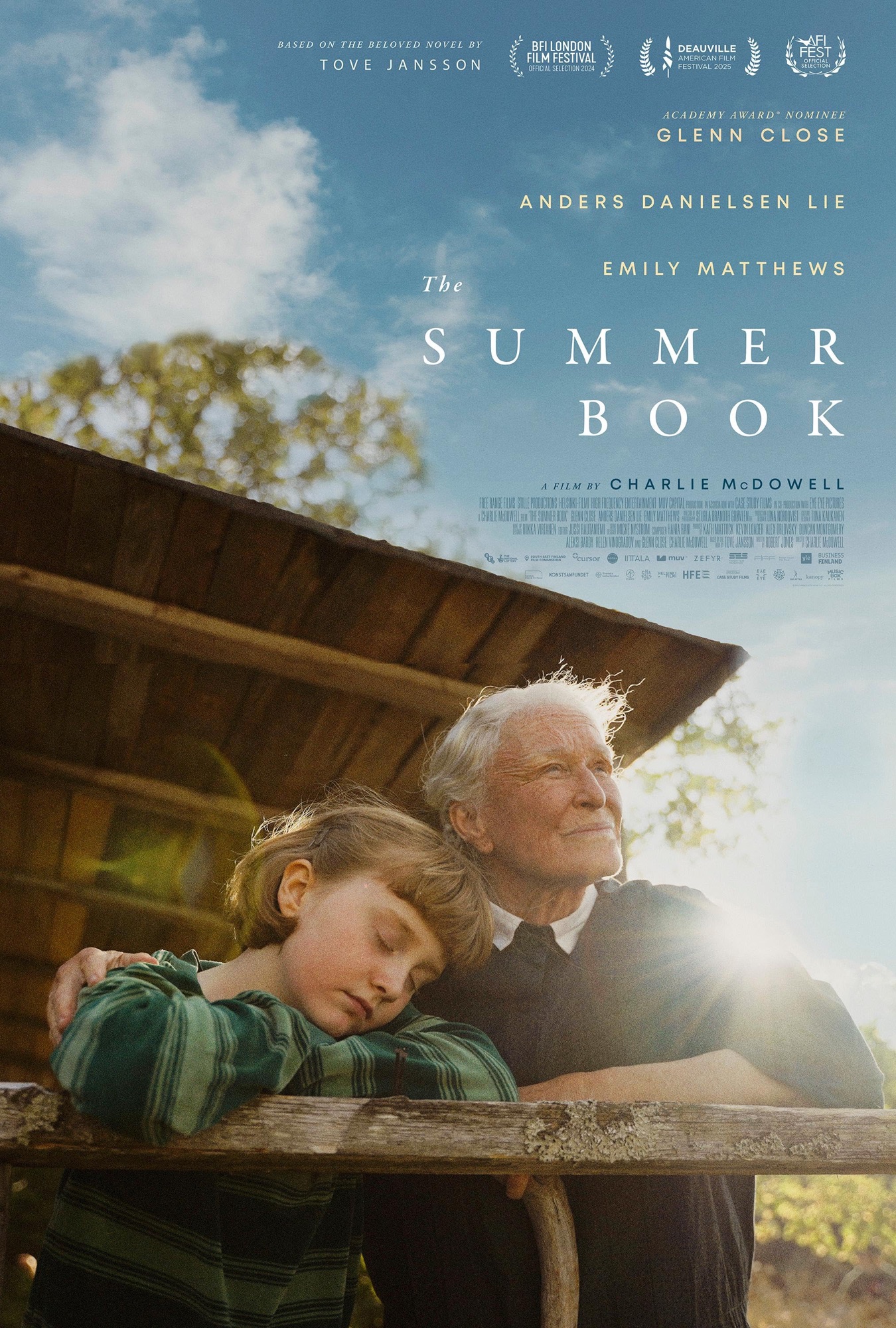


The Summer Book, directed by Charlie McDowell, gives Glenn Close a role shaped by weathered wisdom and stubborn vitality, and she turns it into a portrait of a woman who knows how to hold a family together even when the center has fallen away. The story follows Sophia, played with luminous restraint by Emily Matthews, as she spends the summer with her father and grandmother on a small island in the Gulf of Finland after her mother’s death. What emerges is a coming‑of‑age tale built from salt air, silence, and the slow rebuilding of trust.

Close’s Grandmother becomes the island’s pulse. She carries age with a fierce steadiness, refusing to let grief turn the world small. Her scenes with Sophia glow with a kind of rough affection, the kind that teaches a child how to stand inside sorrow without being swallowed by it. She is a keeper of rituals, a builder of small adventures, a reminder that old age can still hold fire.

Matthews gives Sophia a gaze that absorbs everything—the shifting moods of the sea, the brittle edges of her father’s sadness, the strange comfort of her grandmother’s blunt humor. Her coming‑of‑age unfolds not through dramatic revelation but through the accumulation of days: climbing rocks, wandering forests, listening to stories that carry the weight of generations. She learns that childhood does not end in a single moment; it dissolves slowly, shaped by the people who stay.

Anders Danielsen Lie plays the father with a quiet ache, a man who has not yet learned how to speak the language of mourning. His grief sits in his posture, in the way he watches Sophia from a distance, in the way he tries to keep the world orderly even as it slips through his hands. His scenes with Close crackle with unspoken history, two adults negotiating how to raise a child while carrying their own wounds.

The film becomes a portrait of family grief, not through melodrama but through the rhythms of daily life. Meals cooked without appetite, walks taken to avoid conversation, the way a house feels different when someone is missing. McDowell lets the camera linger on small gestures—a hand brushing sand from a table, a father repairing a boat, a grandmother staring at the horizon—each one a quiet admission of longing.

Old age is rendered with rare dignity. Close’s character refuses to be softened or sentimentalized. She is sharp, stubborn, and deeply alive. Her relationship with Sophia becomes a bridge between generations, a reminder that the very old and the very young often understand each other best. Through her, the film honors the strange clarity that comes with age, the ability to see life’s fragility without fear.

The father’s grief takes a different shape. He is an artist, and the film traces how he begins to transform his sorrow into his work. His sketches, once controlled and precise, grow wilder, more open, as if he is learning to let the world touch him again. His art becomes a map of his healing, a way to speak to his daughter when words fail.

Ingvar Sigurdsson’s Eriksson and Pekka Strang’s Mr. Malander add texture to the island’s world, offering glimpses of community and the ways neighbors witness one another’s pain. Sophia Heikkilä’s Mrs. Malander brings warmth and a gentle steadiness, grounding the film’s emotional landscape.

McDowell’s direction favors stillness, letting the island become a character of its own. The Gulf of Finland feels both sheltering and vast, a place where grief can echo without overwhelming. The film’s lyricism grows from this landscape, from the way light moves across water, from the way summer holds both promise and melancholy.

By the final scenes, The Summer Book has woven a gentle spell. It offers no grand catharsis, only the truth that families survive by carrying one another through seasons of loss. Close anchors the film with a performance full of grit and grace, and Matthews gives Sophia a tender resilience that lingers long after the credits.

Letter Grade: B+.


Leave a Reply