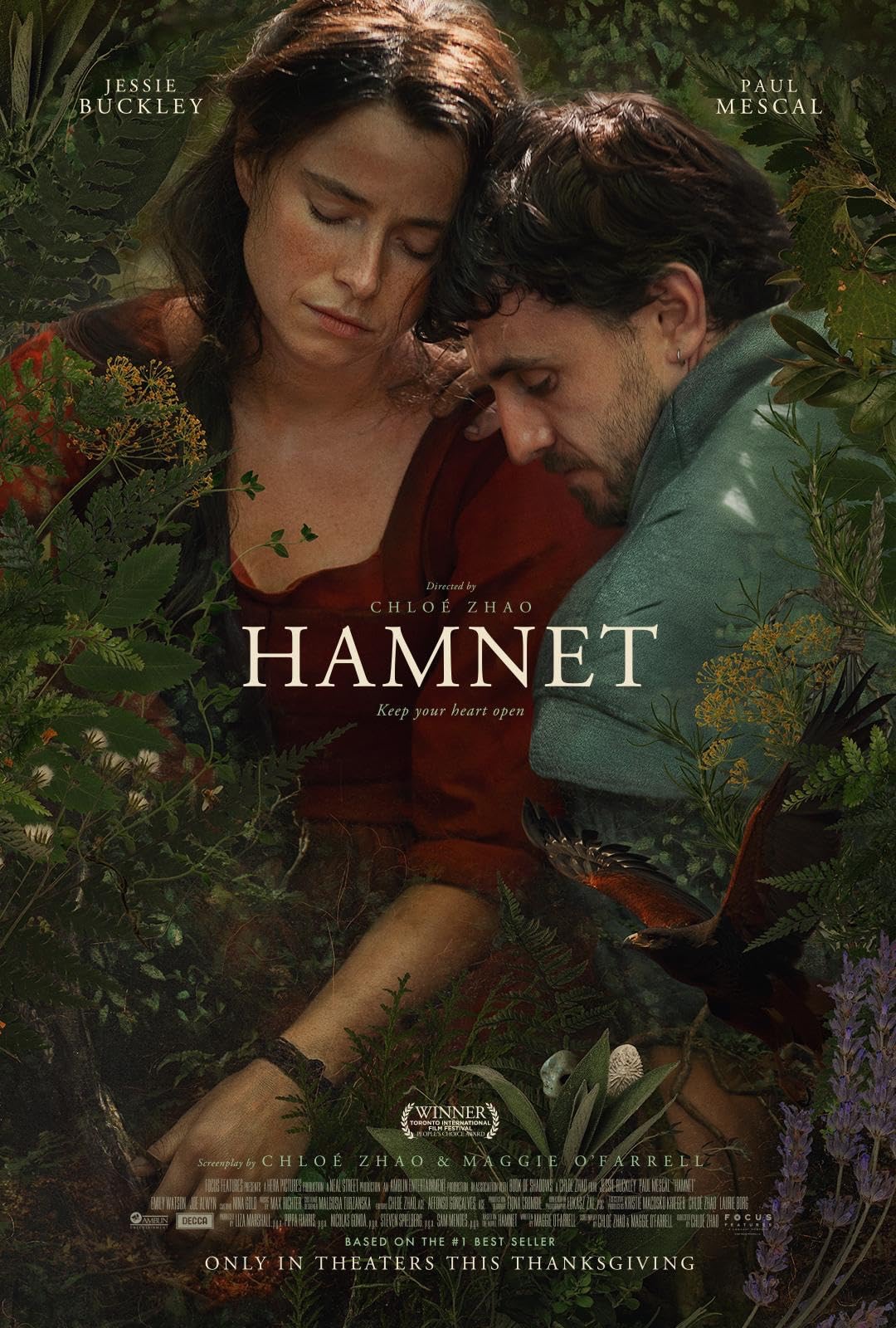


Chloé Zhao’s Hamnet bursts onto the screen as a luminous testament of cinematic passion—an evocative origin story, an intimate family saga, and a rich biography of Shakespeare’s imagination woven seamlessly into one breathless narrative. Anchored by powerful performances from Jessie Buckley and Paul Mescal, the film flows with the effortless grace of a folio page turning itself, unveiling how a humble household in Stratford became the birthplace of perhaps the most profound meditation on loss the world has ever known.

Zhao captures Agnes—played with fierce, woodland radiance by Buckley—as the film’s captivating guiding spirit. Her falconry glove, herbal wisdom, forest cave, and visions of future children transform into vivid metaphors for her unique worldview. When William first witnesses her summon a hawk from the sky, the film celebrates wonder as a profound truth. Their initial encounters—his tale of Orpheus and Eurydice, her prophecy of greatness—sparkle with mythic shimmer while staying grounded in the rich soil of Warwickshire.

The portrayal of family life deepens as Susanna arrives, followed by the twins, Hamnet and Judith. Zhao crafts these moments with tender intimacy: Agnes bringing Judith back to life, children darting through the woods, and the hawk’s burial, whose heart carries their hopes upward. Jacobi Jupe’s Hamnet radiates curiosity and warmth, especially in his devotion to Judith and his longing to step into his father’s theatrical world.

Mescal’s Shakespeare is a man torn between two worlds—his humble home in Stratford and the vibrant, chaotic stages of London. His rise in the theater, owning Stratford’s grandest house, and his encounters with puppet shows haunted by plague and death all paint a vivid picture of an artist immersing himself fully in the senses of the world. Zhao portrays his creative awakening as deeply intertwined with the joys and sorrows of his family.

When the plague claims Judith and Hamnet chooses to lie beside her out of pure sibling devotion, the film shifts into its most compelling mode. His vision of himself on a stage behind a scrim, calling for Agnes, becomes the emotional heartbeat of the entire story. Agnes’s healing gifts, often a source of strength, are pushed to their limits, and the film pays tribute to her love through scenes of profound stillness and tenderness. William’s return to find Hamnet lying silent becomes the poignant intersection where biography and myth beautifully merge.

From this point, Hamnet evolves into a powerful story of how grief transforms into art. Agnes’s journey to London, her first encounter with Hamlet, and her epiphany that the play is a heartfelt tribute to her son form the film’s most moving sequence. Noah Jupe’s Hamlet, reaching out toward the audience as he dies, forges a tender connection between the living and the lost. When Agnes touches his hand and witnesses Hamnet smiling on the stage of his final vision, the film offers a poignant gesture of release—purely intimate yet infinitely cosmic.

Zhao’s direction imbues every forest path, candlelit room, and Globe rehearsal with a vivid sense of breath and heartbeat. Buckley and Mescal deliver performances brimming with dedication, bravery, and radiant emotional clarity. The supporting cast—Emily Watson’s Mary, Joe Alwyn’s Bartholomew, Olivia Lynes’s Judith—add depth and grace, enriching the film’s rich tapestry.

As a biography of Shakespeare, Hamnet vividly paints a portrait of the artist molded by family, love, and the son whose name echoes across generations. It thoughtfully explores grief, showing how sorrow transforms into language, memory into drama, and a father’s mourning beats at the core of Hamlet. The film serves as both a heartfelt tribute and a genesis story, carrying the spirit of a boy into the sky—just as Agnes once taught her children to see the hawk’s heart soaring above the trees.

Grade: A


Leave a Reply