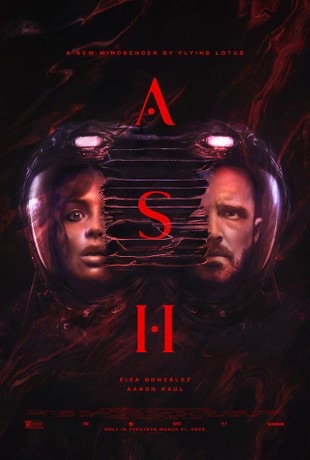


Flying Lotus’s Ash, now streaming on Shudder, is a bold attempt at a cerebral sci-fi thriller—equal parts paranoia, body horror, and meditative grief-trip. It strives for the haunted, airless intensity of Alien and the narrative unreliability of Sunshine, but doesn’t always cohere. Its ambitions often outpace its execution, and while not everything sticks, it’s never dull—and that alone makes it worth watching.

At the center of the film is Eiza González, delivering a grounded, emotionally turbulent performance as Riya Ortiz, a scientist who awakens alone on a dying research station, surrounded by dead crewmates and disjointed memories. González is the movie’s greatest asset; her descent from confusion to revelation to defiance is convincing, even when the structure wobbles around her. She’s asked to carry nearly every scene—and essentially does.

The film’s strongest segments revolve around mood and world-building. Flying Lotus (credited here as director and composer) uses a minimalist score, flickering lights, and hallucinatory flashbacks to evoke a crumbling mindscape. The station, bathed in metallic shadows and cluttered with the debris of scientific rigor and abandoned hope, feels palpably haunted.

The plot, on paper, is rich with promise: terraforming, alien parasites, identity fragmentation, and ecological trespass. But in execution, the story sometimes buckles under its density. Characters like Brion (Aaron Paul) and Kevin (Beulah Koale) are compelling in flashback or hallucination, but never fully dimensional. Paul does solid work, but he’s constrained by his character’s spectral ambiguity.

What Ash gets mostly right is atmosphere. Like Ridley Scott’s Alien, it thrives in confined corridors, hushed paranoia, and the creeping suspicion that what you see is not the truth. But where Alien builds tension with tight narrative clarity and escalating danger, Ash meanders. The constant unfolding of new revelations—Riya’s infection, Brion’s death, Clarke’s reappearance—creates momentum, but not always clarity. It’s sci-fi as a mood board, not a blueprint.

The creature element—rooted in nanotech parasitism rather than xenomorphic horror—is intellectually fascinating but emotionally distant. The parasite has ideas (“you are inefficient… I will evolve you”), but its presence never terrifies in the way it should. It’s more allegory than antagonist, which makes for thoughtful viewing but undercuts immediate visceral threat.

That said, the final act is surprisingly satisfying. Riya’s confrontation with the parasite, symbolic and literal rejection of evolution through infestation, and her fight to reclaim autonomy feel earned, even if the action feels more budget-restrained than kinetic. The welding torch finale is a clever inversion of the Alien flamethrower trope: gritty, desperate, and personal.

Thematically, Ash is preoccupied with memory, guilt, and the strange way trauma reorganizes our reality. Riya is the classic unreliable narrator, but her arc—realizing she is both victim and vector—is rendered with enough nuance to avoid cliché. There are echoes of Solaris in how the environment reshapes the mind, though Ash lacks that film’s philosophical clarity.

Ultimately, Ash is a film that invites admiration more than affection. It’s too scattered to be a new sci-fi classic, but too thoughtful to dismiss. Flying Lotus swings big here, and while he doesn’t land every blow, he delivers a moody, original hybrid of psychological horror and speculative fiction.

It’s a B-grade movie in terms of cohesion, but an A for ambition—and sometimes, that’s enough. Streaming on Shudder.


Leave a Reply